By Ginni Gold · October 28, 2025
The AI Takeover of Talent Acquisition
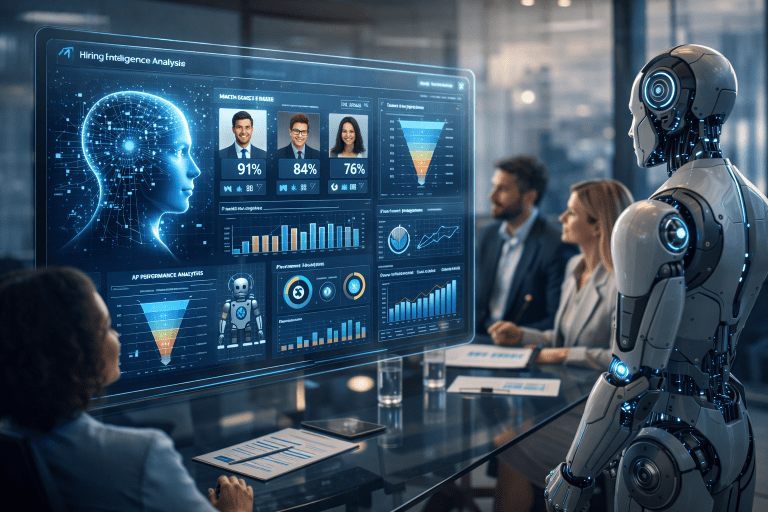
Artificial intelligence has permanently transformed the way organizations hire. What started as simple automation for resume parsing has evolved into AI recruiting tools that predict performance, gauge cultural fit, and improve long-term retention.
The shift is dramatic. In the 2024 LinkedIn Global Talent Trends Report, 68% of talent leaders said AI already plays a role in their hiring strategy.
According to Deloitte’s 2023 Human Capital Trends Study, organizations using AI recruiting tools saw 25% faster hiring cycles and 20% higher quality-of-hire scores.
AI has leveled the playing field for HR teams and given them the opportunity to compete for talent in an environment where knowledge gaps, speed, and candidate experience define success.
What AI Recruiting Tools Do in Talent Acquisition
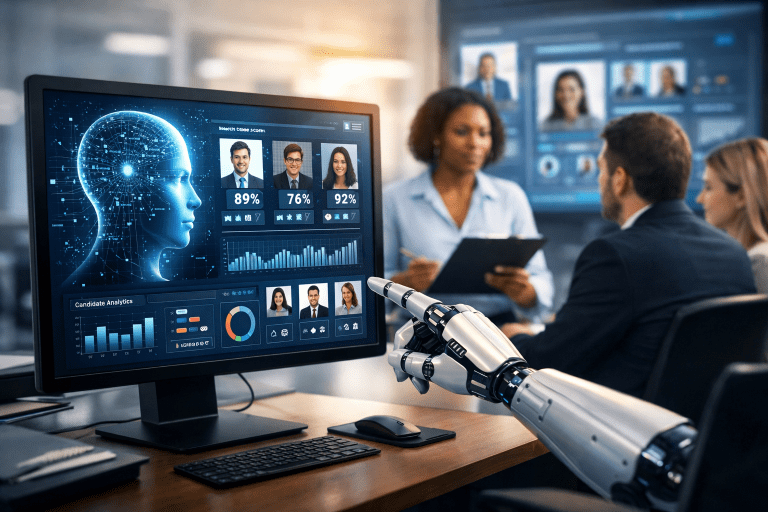
AI recruiting tools today use machine learning, predictive analytics, and natural language processing to enhance and automate every stage of hiring.
Core Capabilities:
- Smart Resume Parsing: Reads resumes contextually in addition to keyword searching.
- Candidate Ranking: Prioritizes candidates by predictive fit and retention.
- Chatbots and Automation: Conducts initial screening, FAQs, and scheduling 24/7.
- Bias Detection: Detects decision-making patterns to ensure fairness.
- Predictive Retention Analytics: Anticipates turnover before it happens.
- Data Insights: Provides leaders with real-time dashboards to monitor hiring health.
In short, AI replaces speculation with intelligence. Recruiters can spend less time managing systems and more time connecting with people.
The Importance of AI Recruiting Tools in 2025
Recruitment has become increasingly complex. Employers face record labor shortages, rising candidate expectations, and the demand for speed.
According to the U.S. Bureau of Labor Statistics JOLTS Report, 2024, there were over 9 million job openings that year, with healthcare, retail, and logistics showing the highest demand. The average cost-per-hire reached $5,200, and time-to-fill exceeded 40 days in several sectors (SHRM Talent Acquisition Benchmark 2024).
That’s where AI talent acquisition comes in. It improves hiring speed without sacrificing accuracy, reduces cost-per-hire, and gives HR teams predictive visibility.
Real-World Examples: How AI Recruiting Tools Create Measurable Impact
AI isn’t theory—it’s transformation in motion. Recruiters use AI recruiting tools to solve challenges that were once thought impossible to address.
1. Healthcare: Predicting Retention and Reducing Burnout
A hospital network with 15,000+ employees had a 30% first-year nurse turnover rate. With Cadient SmartSuite™, SmartTenure™, and SmartMatch™, they predicted which candidates would stay and perform well.
Results: 27% drop in early turnover; 33% faster hiring; 11% higher patient satisfaction.
Impact: Predictive analytics identified behavioral traits tied to attrition, such as learning agility and teamwork.
Source: Cadient client HR summary, 2024.
2. Retail: Scaling Up Seasonal Hiring
A national retailer with 40,000 annual hires used SmartMatch™ to streamline high-volume recruiting. The platform identified candidates most likely to convert.
Results: 45% faster hiring; $1.2M annual savings in recruiter labor.
Impact: Candidates received same-day responses via SmartTexting™, boosting satisfaction and brand loyalty.
3. Logistics: Reducing Bias, Increasing Consistency
A logistics provider replaced unstructured interviews with SmartScreen™, ensuring uniform scoring across regions.
Results: 19% bias concern reduction; 21% year-over-year diversity increase.
Source: HR Compliance Review Board, 2024.
4. Technology: Developing Predictive Hiring Pipelines
A remote-first tech company used SmartScore™ to evaluate skills and culture fit.
Results: 38% higher retention for remote hires; 2 weeks faster average hire.
Impact: AI uncovered nontraditional candidates with measurable success potential.
5. Hospitality: Engagement Beyond Day One
A national restaurant brand implemented SmartFeedback™ to capture post-hire engagement.
Results: 25% higher onboarding satisfaction; 22% lower manager turnover.
Source: Cadient Customer Success Report, 2024.
How AI Recruiting Tools Improve Candidate Experience
AI enhances the candidate journey through personalization and responsiveness.
In the Talent Board’s 2024 Candidate Experience Report, 82% of applicants said automated communication improved their perception of employers.
Cadient’s SmartTexting™ and SmartConnect™ keep candidates informed every step of the way. Together with SmartMatch™, they deliver experiences that feel personal, transparent, and fast.
The Ethical Frontier: Responsible AI in Talent Acquisition
The power of AI demands governance. Cadient’s framework addresses EEOC and GDPR compliance while aligning with The IEEE Ethics Initiative.
All SmartSuite™ models are audited for bias and provide explainable recommendations for each decision. Transparent AI builds trust—both with candidates and within hiring teams.
The ROI of AI Recruiting Tools
The financial case for AI recruiting tools is clear.
| Metric | Before AI | After AI | Improvement |
| Time-to-Hire | 30 days | 17 days | 43% faster |
| Cost per Hire | $4,700 | $3,000 | 36% lower |
| Year-One Turnover | 29% | 20% | 31% reduction |
At scale, these results translate into millions in savings—and stronger, more cohesive teams.
The Future of AI Recruiting Tools in Talent Acquisition
We’re entering a new age of AI recruiting tools, expanding beyond hiring into the entire employee lifecycle.
Trends to Watch:
- Predictive Workforce Planning: AI anticipates talent gaps and skill shortages.
- Hyper-Personalized Experiences: Candidate journeys adapt in real time.
- Explainable AI Regulation: Governments demand algorithmic transparency.
- Cross-Platform Learning: AI integrates with LMS and performance tools.
- AI for DEI: Algorithms track diversity and equity progress.
Gartner’s 2025 HR Tech Outlook reports that 75% of enterprises plan to invest in AI-driven talent systems by 2026.
The Human-AI Partnership in Hiring
The future isn’t AI versus humans—it’s AI and humans together. Recruiters using AI recruiting tools reclaim time for strategy, storytelling, and relationship-building.
The PwC Workforce Study 2024 found that 74% of employees are comfortable working alongside AI when they understand its role.
Recruiters aren’t being replaced—they’re being elevated. AI surfaces hidden talent, while humans bring empathy and connection.
Overcoming AI Recruiting Tool Adoption Barriers
Despite its benefits, AI adoption in recruiting faces common obstacles:
- Fear of Job Displacement – AI doesn’t replace recruiters; it enhances them.
- Data Privacy Concerns – Trusted vendors like Cadient use encrypted, anonymized data handling with full legal compliance.
- Change Management – Cadient supports culture transformation through pilot programs and leader engagement.
- Cost Misperceptions – Modular pricing and fast ROI (typically <1 year) make SmartSuite™ accessible at scale.
Companies that embrace AI and train their teams to use it strategically will convert disruption into dominance.
Cadient SmartSuite™: AI that Thinks, Learns, and Hires with You
Cadient SmartSuite™ is more than software—it’s a strategy. Its modular intelligence adapts to every hiring challenge and evolves with each hire.
From SmartMatch™ sourcing to SmartTenure™ retention prediction, SmartSuite™ provides leaders with clarity across the entire funnel.
Modules like SmartHire™, SmartScreen™, SmartScore™, and SmartFeedback™ can operate individually or as an integrated suite—delivering measurable results in weeks.
Explore more in Cadient’s Resource Center or see SmartSuite™ in action.
Conclusion: AI Recruiting Tools Expand, Not Replace, Human Potential
AI recruiting tools have shifted talent acquisition from reactive to predictive. Top teams now hire with foresight, precision, and measurable ROI.
HR leaders agree: use AI or be left behind. Those who embrace AI talent acquisition today will define the workforce of tomorrow.