The US Travel Association claims that the hospitality business in the United States is a transformative money earner, employing over 16 million people and contributing almost $660 billion annually to the GDP. That’s massive.
However, unexpected changes are currently taking place in the business due to changing and highly demanding client tastes, technology improvements, and a renewed emphasis on sustainability and inclusion. Strong recruitment methods are critical to ride post-pandemic recovery. Attracting, maintaining, and nurturing outstanding and customer-friendly people is critical to providing exceptional guest experiences and meeting companies’ business objectives. The industry has several obstacles, including a 73.8% annual turnover rate and a competitive job market (Bureau of Labor Statistics).
Emerging Trends Shaping Hospitality Recruitment
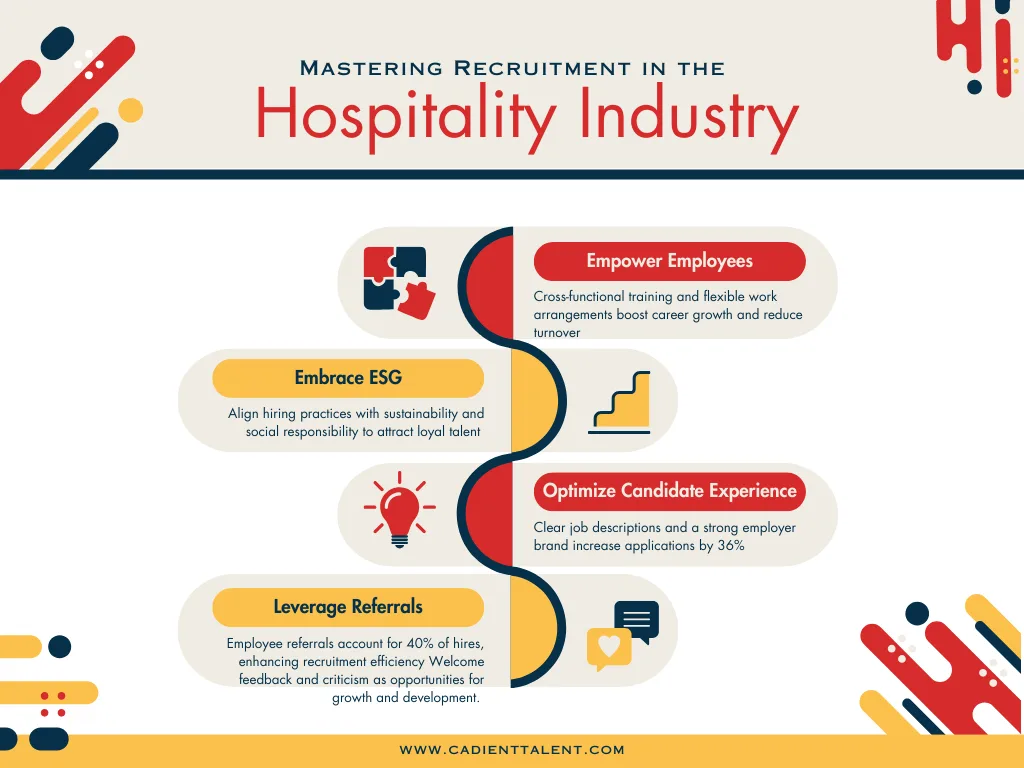
Empowering Employees with Cross-Functional Training and Flexible Work Arrangements
One major evolution in the recruitment of hospitality workers is the focus on providing training across variable functions and offering the option of flexible work schedules. The new-age workforce is looking for chances to advance careers and improve their balance between work and personal life. Hotel establishments can provide a more fulfilling work environment by allowing employees to participate in activities of different departments, for example, having front desk staff assist with digital marketing campaigns. This method helps employees grow and gives hotels important information while lowering staff turnover.
An example would be if a hotel provided basic front desk training to its housekeeping staff so they could help out during busy periods. This adaptability can result in increased wages for workers and enhanced job contentment. A survey conducted by the AHLA found that 78% of hotel workers think training in different roles can help their career advancement. Moreover, strong technology and communication tools are necessary to promote successful teamwork among different departments, guaranteeing smooth operations and a unified team atmosphere.
Embracing ESG (Environmental, Social, Governance) Principles in Hiring
Today, ESG principles are driving recruitment strategies in the hospitality industry. Workers, clients, and shareholders are all increasingly focused on a company’s dedication to environmental sustainability, social responsibility, and ethical governance. Hotels need to rejig their corporate strategy to conform to ESG best global practices, to ensure that their hiring take these values into account.
For instance, a hotel dedicated to promoting environmental sustainability should prioritize hiring individuals who have experience in eco-friendly practices or community management. Being authentic and real is crucial because making false claims about a hotel’s environmental initiatives can kill its reputation and credibility. A research study conducted by Cone Communications revealed that 88% of customers show greater loyalty towards businesses that back social and environmental causes.
Optimizing Candidate Experience
Writing Clear Job Descriptions and Building a Strong Employer Brand
Creating a carefully written job description is the initial process in drawing in perfect candidates. The content should be easy to understand, brief, and centered on the candidate’s requirements and desires. Emphasizing the employee value proposition (EVP) and establishing a robust employer brand are equally important. This involves presenting the company culture, career advancement chances, and any special benefits that differentiate the hotel from rivals.
Designing job advertisements that are both simple to comprehend and optimized for mobile devices, can truly transform the application process, allowing a wider range of applicants to explore your job openings. Renowned for their broad reach and easy-to-use interfaces, platforms such as LinkedIn and Indeed, can be effective in promoting new opportunities. Job listings that have concise job titles and clearly defined responsibilities get 36% more job applications
Leveraging Employee Referrals and Social Media
Employee referral programs are usually very successful in drawing in top-quality employees through peer reference. Providing rewards for successful referrals and simplifying the referral process motivates employees to engage more with the company. Platforms like LinkedIn, Facebook, and Instagram are effective tools for advertising the employer brand and connecting with a large pool of potential candidates.
A hotel may implement a referral bonus program that rewards employees for recommending potential hires successfully recruited and remaining employed for a specific duration. Also, to-the-point posts on social networking platforms showcasing employee stories, hotel environment, and professional growth chances can draw in passive job hunters and create a favorable brand reputation. A study conducted by Jobvite found that 40% of all hires are made through employee referrals.
Assessing Personality Along Skills
In hospitality recruitment, it is fundamentally important to evaluate candidates’ personalities, values, and mindsets as it is to assess their skills and experience. Hospitality brands demand specific kinds of staff to provide their individualized guest experiences. Evaluating candidates’ passion, purpose, and adaptability through pre-screening assessments can assist in identifying individuals who resonate with the organization’s values.
For example, a high-end hotel may seek individuals who possess a sharp attention to detail and a dedicated focus to providing outstanding guest service as part of their personality,whereas a smaller hotel may value innovation and a custom-tailored method. Behavioral, situational, and role-play interviews offer a more in-depth understanding of a candidate’s fit for the position and the organization’s culture.
Strategies for Transforming Hospitality Recruitment
Choosing the Right Recruitment Channel
Choosing the best recruitment platforms is essential to connect with the most suitable applicants. Websites such as Indeed and Glassdoor, social networking sites, personal recommendations from coworkers, and professional gatherings are all useful tools for finding employment. Every channel has its own benefits. While job boards offer wide visibility, social media can efficiently reach particular target audiences.
Attending industry events and job fairs can be a master stroke. These meetups present chances to interact with potential applicants in person and add a personal, emotional element to the hiring process. Moreover, establishing relationships with hospitality schools and programs can generate a steady stream of skilled potential employees, across the year. As per the Bureau of Labor Statistics, the hospitality sector is expected to increase by 9% between 2021 and 2031, resulting in the creation of approximately 135,200 new positions.
Thorough Interviews and Assessment Processes
It is crucial to conduct thorough, comprehensive interviews and assessments to unlock a top-class talentpool. Behavioral interviews, which hinge on past behaviors and experiences, can provide invaluable insight into a candidate’s potential performance in future scenarios. Situational interviews test problem-solving skills with hypothetical scenarios, while role-play interviews assess practical abilities with real job tasks.
Using a combination of these techniques gives a complete perspective of a candidate’s skills and suitability for the position. Furthermore, utilizing methods such as personality assessment tests, can assist in pinpointing candidates whose values and work styles are in line with the company culture, thereby enhancing the likelihood of a successful match.
Optimizing the Onboarding Process
An organized onboarding procedure uncovers the atmosphere for how a new employee will experience the company. It is essential to offer a friendly reception, set clear guidelines, and provide thorough training on duties, tools, and policies. Matching novice employees with seasoned colleagues for mentorship and guidance can further aid in their assimilation into the team.
Frequent communication between new employees and their supervisors aids in addressing any issues and ensuring the new hires feel supported. Continuing to communicate is crucial in cultivating a positive work atmosphere and decreasing premature employee departures. As per the Society for Human Resource Management (SHRM), firms that implement a robust onboarding procedure enhance new employee retention by 82% and increase productivity by more than 70%.
Implementing an Effective Employee Retention Strategy
Retaining employees is the biggest bottleneck. It is crucial to tackle the reasons for turnover, like limited chances for advancement and an unhealthy work-life balance. Providing attractive pay, special benefits, and adaptable work hours can greatly boost employee contentment and commitment, leading to more committed workers who go beyond the rigid lines of job roles.
Efficient employee engagement and recognition initiatives are equally essential. Acknowledging and compensating employees for their efforts promotes a feeling of gratitude and inspires them to remain loyal and committed to the organization. Fostering a positive work environment that promotes teamwork, creativity, and mutual respect enhances employees’ dedication.
Conclusion
Recruitment in the hospitality sector is swiftly evolving due to new trends and emerging candidate expectations. Hotels can draw in and keep top talent by adopting cross-functional training, ESG principles, and a candidate-focused method of engagement. Using the correct recruitment sources, completing comprehensive evaluations, and improving the onboarding procedure are vital stages in excelling at hospitality recruitment.
Moreover, ensuring long-term success involves implementing successful employee retention strategies, such as providing competitive compensation and cultivating a positive work environment. In order to remain competitive in the hospitality market, it is crucial to stay informed on the latest trends and strategies as the industry evolves to face new challenges and seize opportunities.
To access more insights and explore complete healthcare staffing solutions, go to Cadient. Adopt these methods to create a strong, energetic team that enhances guest experiences and boosts company expansion.