By Manoj Kumar · March 6, 2026
In the cutthroat world of talent acquisition, conventional resume screening is rapidly being relegated to the dustbin of a bygone era. Picture a hiring manager with a mountain of 1,000 applications for a single retail management position. Statistically, that recruiter will spend an average of just six to seven seconds glancing at each resume before making a “yes/no” decision. In that blink of an eye, potential high-performers are inevitably lost to fatigue and unconscious bias.
This is the “noise” of modern hiring. Today, the problem is no longer simply locating individuals; it’s locating the correct individuals with surgical accuracy. This is where AI candidate matching comes in, a technology that has transitioned from being a tool of the future to a basic requirement for any organization that is serious about the accuracy of hiring. By the end of this guide, you will know how this technology works, why it is the solution to high turnover, and how it turns “gut feeling” hiring into a science.
What Is AI Candidate Matching?
AI candidate matching is, quite literally, the use of sophisticated complex machine learning and natural language processing techniques to automatically match a candidate’s skills, experience, and fit to a particular job opening. Unlike previous systems that would filter out a candidate for a “Software Engineer” position in favor of a candidate for a “Developer” position, as described in a job posting, AI recruitment matching algorithms can read between the lines.
This technology is like having an intelligent personal assistant that works 24/7. It analyzes candidate paths, infers candidate skills, and computes the probability of success based on past performance.
How Does an AI Candidate-Job Matching Algorithm Work?
To have confidence in the output, it is necessary to understand the “brain” behind the screen. An intelligent candidate matching algorithm does not simply “see” words; it sees connections.
What are the key technical components of these algorithms?
- Semantic Understanding: The AI can recognize that a person with “experience in guest relations” is an ideal match for a “customer success” role, even if the words don’t exactly match.
- Skills Inference: The candidate-job matching algorithm can anticipate a candidate’s secondary skills. For example, if a person’s resume mentions “React.js,” the AI will understand that they also have skills in “JavaScript.”
- Predictive Scoring: Rather than a simple “yes” or “no,” candidates receive a compatibility score. This enables recruiters to optimize their day by beginning with the “95% match” candidates first.
Why Is AI Hiring Technology Critical for Accuracy?
Hiring accuracy is the measure of how well a new hire actually fits the role and stays with the company. Traditional methods often fail here because they are reactive. AI hiring technology turns the process into a predictive one.
How does AI specifically improve the quality of hire?
- Elimination of Human Fatigue: A human recruiter’s 100th resume review of the day is rarely as accurate as their first. AI maintains 100% consistency and AI hiring accuracy, whether it is scanning its first or its ten-thousandth profile.
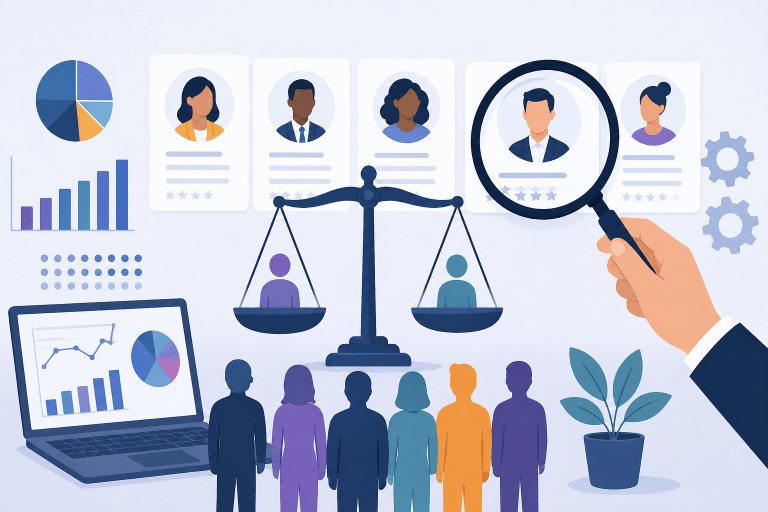
- Reduction of Unconscious Bias: By focusing on objective data points such as skills, certifications, and years of relevant experience, an AI talent matching platform can be configured to ignore demographic identifiers that often trigger subconscious human bias.
- Expanded Talent Discovery: Sometimes the best candidate didn’t apply for the current role but is sitting in your existing database from six months ago. AI can “rediscover” these candidates and match them to new openings they are perfectly suited for.
What Are the Benefits of Using AI Candidate Matching Software?
The ripple effect of AI candidate matching software extends beyond “choosing the right person.” It is having a profoundly positive impact on the entire HR process.
Also Read: Benefits of AI Candidate Matching for Enterprise Hiring
How does it transform the daily lives of recruiters?
- Faster Time-to-Shortlist: What used to take a week now takes seconds. Recruiters get top talent before competitors do.
- Improved Retention Rates: By matching candidates, companies are experiencing a reduction in 90-day turnover.
- Enhanced Candidate Experience: It now takes far less time for candidates to receive feedback. While it may be ‘no,’ it is still better than the ‘black hole’ of the traditional process.
Real-World Impact: By using AI matching software, companies are experiencing a 40-60% reduction in time-to-hire. Moreover, a double-digit increase in candidate satisfaction.
How to Implement AI Candidate Matching Effectively?
A non-AI system to an AI-based system does not happen by flipping a switch. A thoughtful strategy is required. One needs to ensure that the AI system is integrated with your unique culture.
What steps should you take for a successful rollout?
- Define Success Metrics: Are you trying to improve speed, diversity, or retention? Your AI recruitment matching parameters should be set accordingly.
- Clean Your Data: The AI system is only as good as the data it’s given. Make sure that the job descriptions you provide to the AI system are clean, and that the hiring data you provided in the past is organized.
- Human-in-the-Loop: Let the AI handle the ranking and recommendations, but let your human recruiters make the final match. The best of both worlds can be achieved by taking a “co-pilot” approach where humans handle empathy.
Conclusion: The Future of Hiring is Intelligent
With AI candidate matching, you get the clarity and accuracy you need to assemble an effective team in today’s changing market. Not only are you filling your job openings, but you are assembling your team with winning candidate matches and performances.
Key Takeaways:
- Accuracy over Volume: AI replaces “how many” with “how many qualified.”
- Consistency is King: AI ensures that every candidate gets the same level of scrutiny.
- Scalability: Now we can do enterprise recruitment without adding a single person to our recruitment team.
At Cadient, we recognize that your front line is your bottom line. Our SmartMatch™ solution is engineered to be your first and best filter, so that the brightest and best minds are not lost in the process.
Ready to harness the power of AI in your hiring accuracy? Contact us today for a Cadient demo and begin hiring with confidence.
Also Read: Automated Candidate Screening: Definition, Benefits, and Use Cases
Frequently Asked Questions (FAQs)
1. What is the difference between keyword searching and AI candidate matching?
Keyword searching relies on exact keyword matches, e.g., “Project Manager.” So, if the candidate has “Team Lead” as their profile, they would be missed. With AI candidate matching, “Team Lead” would be recognized as having the same skills as “Project Manager.”
2. Can AI candidate matching really reduce hiring bias?
Yes, if done properly. It is possible to make the matching process completely “blind” to factors like name, gender, or zip code, so it only looks for skills/experience.
3. Will AI replace human recruiters?
Absolutely not. AI is meant to be a productivity aid, not a replacement for human intuition and judgment. It is meant to do the “heavy lifting” of data processing and preliminary filtering, so that recruiters can get back to what really matters – interviewing, culture-fitting, and relationship-building.
4. How long does it take to see results from AI candidate matching software?
Most organizations see an immediate impact on “Time-to-Fill” metrics within 30 to 60 days of using AI candidate matching software. Long-term metrics, like improved employee retention and the accuracy of hires, typically take 6 to 12 months to measure.