By Abhishek Patel · March 20, 2026
High volume hiring within an enterprise is not a process that tends to break in dramatic fashion. There are requisitions. There are recruiters working managers. There are applicants waiting in line. There are stores or locations that are understaffed. On paper, it’s a good process. In reality, it’s a pain felt as a higher turnover, a slower time to fill, and lost revenue.
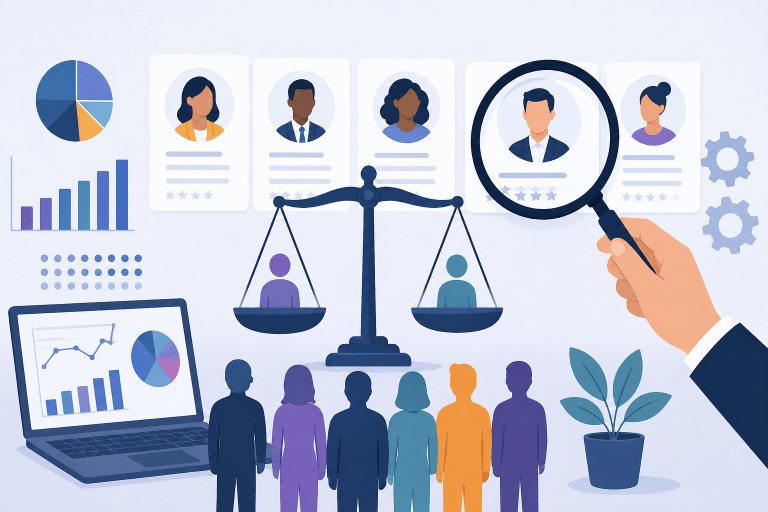
AI hiring for enterprises is a solution to this pain. It’s a solution to replacing a guessing game with hard data on who will perform and who will stick around. It’s a solution to giving talent leaders something they never get in high volume hiring: control.
What is AI Hiring for Enterprises?
Hiring with AI for enterprises is a process that utilizes data models and AI to support all phases of the hiring process. The objective is straightforward: accelerate the process without adding more risk, and improve fit without adding more manual tasks.
In enterprise AI recruitment, you are working on three basic problems, and you are solving them with machine learning. The first is that you want to prioritize applicants that are likely to succeed in a given role, and the second is that you want to eliminate manual tasks that are taking place in the hiring process.
The AI-based recruitment software for the enterprise should not be a black box. The best ones show the user the reasons why one candidate has a higher score for the position. They should match your job success metrics, your compliance requirements, and your ground reality. And, of course, they should work seamlessly with your ATS so that recruiters and managers do not have to battle the systems that are supposed to assist them.
Hiring automation for the enterprise has to work across thousands of locations and managers. The pressure is the same in retail, hospitality, healthcare, call centers, logistics, eCommerce, and many other industries that rely on large hourly workforces. You need to ensure the quality of the hiring process everywhere, and AI-based hiring can do that for you.
Also Read: How Enterprises Use AI to Transform Talent Acquisition
Benefits of AI Hiring for Enterprises
The benefits of AI in the hiring process begin to manifest as soon as the guessing work is taken out of the equation. You see less noise in the recruiters’ workloads and more of the candidates that correlate to your success patterns.
Faster time to hire without more risk
Conventional high volume hiring forces your teams into a cycle of reactivity: screening resumes, pursuing managers, and re-engaging on reqs when initial hires depart. AI can free you from this cycle faster. Enterprise hiring automation can move high priority candidates to the front of the hiring line as soon as they apply.
By leveraging a technology such as Cadient SmartMatch™ and SmartScore™, you can score candidates against known drivers of performance. Your hiring teams don’t have to review a long, flat list of candidates; instead, they can review a short, ranked list of candidates. This means your hiring managers can interview candidates sooner, locations can be filled faster, and service levels can be maintained without compromising on fit.
Better quality of hire and retention
If AI in hiring within enterprises does not connect to retention, you’re simply moving the same problem in the process earlier. Good enterprise AI hiring strategies leverage past data to learn what types of candidate profiles correlate to longer tenures and better performance in each position.
Solutions like our SmartTenure™ predict how likely it is for a candidate to stick around. This gives you a clear signal for retaining people. You’re making hiring decisions based on the cost of turnover rather than preference or instinct. Over time, you build a workforce with people who tend to stick and perform.
Cleaner candidate experience at scale
Talent acquisition automation in the enterprise should enhance the candidate experience, not make it more difficult. By leveraging AI to prioritize and automate candidate routing, you eliminate dead time in the process. Candidates receive communications more promptly. The number of steps between apply and interview is reduced.
SmartTexting™ allows you to keep the candidate informed with timely communications. By automating scheduling and reminders, you minimize no-shows. This is particularly important in a competitive local market where candidates are managing multiple job offers.
Less bias, more consistency
Some benefits that AI recruitment brings to the hiring process include consistency in the evaluation process, regardless of location and managers. With a scoring model, all applicants for a given role are evaluated on the same parameters. You eliminate the variability in ad hoc questions, shifting standards, and local workarounds.
When you implement AI recruitment software for enterprise companies that is designed with compliance in mind, you can conduct fair and job-relevant evaluations, and gain a clear audit trail on what influenced a given recommendation.
Stronger insight into hiring performance
There’s no feedback loop in high-volume hiring. You hire, get busy, and the pain isn’t felt until turnover starts to skyrocket. AI hiring for enterprises ties the hiring process to the downstream effects. You can see which locations are doing the model well, which managers aren’t, and what the downstream effects are.
With Cadient’s SmartSuite™ , you can track time to fill, cost, and retention in one system. This gives talent leaders the ability to negotiate with operations, finance, and the executive team because you can show the impact of better hiring behavior on turnover reduction and stability.
Challenges of AI Recruitment in Enterprises
The concept of enterprise AI recruitment has its own set of challenges. There are risks involved in enterprise AI recruitment, and you may be concerned about disruption or losing control over the process. It is only natural to have these concerns, and it is important to remember that you are in complete control of the results.
Data quality and readiness
The quality and readiness of data play a significant role in AI recruitment strategies. Enterprises may have fragmented candidate information, inadequate performance information, and inadequate tracking of employee turnover. If you have noisy data in your AI recruitment strategy, you are bound to have noisy results.
You need a partner that can effectively function within your enterprise constraints. Cadient can effectively align AI predictions with your available data and improve it over time. The use of SmartSource™ can help you normalize candidate flow into your process. Similarly, SmartScreen™ can help you normalize background checks. This can effectively eliminate noise in your enterprise AI recruitment strategy.
Change management with field managers
The problem with AI hiring in the enterprise space is that the store leaders and the field leaders consider it an option, not a necessity. Many leaders rely on their instincts instead of the scorecard. They need to fill the shifts today, not tomorrow. They see anything new as a source of friction.
There needs to be simple, easy-to-understand communication on the value of the AI to them. Short, easy-to-implement training is better than long presentations of theory. If the leaders see that the people who scored the highest also tend to last the longest in the field, it becomes part of the routine, not one more thing to look at and ignore.
Compliance and fairness concerns
Recruitment AI software for enterprise companies must conform to a strict level of compliance. Legal, HR, and DEI teams want to make sure that the AI is only considering factors that are relevant to the job and is not considering protected attributes.
A mature vendor should be able to provide documentation, testing support, and a clear explanation of the model design. With Cadient, you are in complete control of what is used in the prediction, and the prediction is more accurate because it is based on your data.
Integration with existing systems
Many companies already have large ATS systems and HR systems in place. The concern that management has is that the new AI recruitment implementation projects will interfere with the existing systems.
To successfully implement AI recruitment for an enterprise, it needs to integrate with your existing systems, not replace them. The new SmartSuite™ system integrates well with the most popular ATS systems. This allows you to implement enterprise talent acquisition automation without having to replace your existing systems.
Trust and transparency
If the recruiter and manager don’t understand how AI works, they won’t pay attention to its recommendations. Trust plays a role, too. People want to understand why someone got a certain score and how to apply this score to make decisions.
Search for AI hiring advantages that offer explanations. With SmartScore™, you can see which factors went into the recommendation. This helps recruiters explain it to managers. Managers can also see the patterns and apply them to business results. This helps move AI from black box to operating tool.
Also Read: Talent Analytics for Enterprises: A Complete Guide
How to Implement AI Hiring in Enterprise Organizations
The implementation of AI recruitment does not have to be an overhaul. The most effective AI recruitment programs begin small, with a strong focus on business pain points. From there, it can grow into the broader category of enterprise hiring automation.
Anchor on a specific business problem
Let’s start with a tangible problem. It could be a faster hiring process for distribution centers. It could be high early turnover rates in retail locations. It could be attendance issues in a call center. Choose a particular scenario or use case where AI hiring can drive different results.
Model AI hiring for enterprises as a solution to a particular problem. Determine how success will be measured. Time to fill, retention during the first year, or early absence rates can be powerful metrics. Connect it to costs so that leaders understand the impact on the bottom line.
Audit current hiring workflows
where delays, handoffs, and breakdowns often occur. Many problems result from manual processes, unclear ownership, or inconsistent manager behavior.
This audit will identify where the most value is gained from the enterprise talent acquisition automation. Perhaps it will reveal that screening candidates is not as time-consuming as scheduling managers. In this case, SmartTexting™ and interview coordination should be prioritized.
Prepare your data and criteria
The benefits that AI can provide in the hiring process depend on the level of alignment between data and the success factors for the role. Again, discuss this with your partner and determine what a successful hire looks like in each role.
Clean up data in your ATS that is used in the model. Align job templates. Close old reqs. Standardize reason codes for terminations. It’s the small things that can give your enterprise AI recruitment models a better foundation.
Pilot with tight feedback loops
Target launch of AI-powered hiring in a small number of locations, brands, or geographies. Offer simple training to recruiters and managers on how to use the results, where to access them, and when to override them.
The usage and success of the monitor should be tracked on a weekly basis during the pilot phase. The early results should be discussed with leaders in the field. Anecdotal evidence of improved hires and challenges should also be gathered. This creates a living process to continually fine-tune the scores, thus not treating the implementation of AI-based recruitment as a one-time event.
Scale with governance and support
Once you see consistent results, expand AI hiring for enterprises in more geographic locations and job families. Define a governance model around model updates, compliance, and performance metrics and monitoring.
In this phase, you move from a pilot mode to a standard operating practice. Hiring automation in enterprises is now part of how you staff all your stores, clinics, or facilities. Cadient SmartSuite™ has been designed to support enterprise-scale implementations and has a strong track record in the field.
AI Hiring Use Cases in Enterprise Talent Acquisition
The various use cases for AI hiring in enterprises cover the entire spectrum of enterprise hiring. However, the key is to focus on those decisions where better signal and faster action create value.
High volume hourly hiring
Retail, grocery, hospitality, and eCommerce businesses all have ongoing hourly staffing needs. When these go unfilled, it can cause direct revenue losses. AI hiring for enterprises can help you find applicants for these roles and move them through the hiring process quickly.
SmartMatc™h and SmartScore™ can rank candidates as soon as they apply. SmartTexting™ can initiate outreach and scheduling. SmartScreen can conduct background checks. This process can save time in chasing applicants who do not respond.
Seasonal and surge staffing
Some businesses experience high seasonal surges in retail, logistics, or customer service. With conventional tools, it’s a guessing game on how many of these new recruits will pass training and stay on until the season ends. AI recruitment tools for enterprises can provide better visibility into candidate quality during these surges.
Predictive scoring allows you to better filter applicants that are more likely to pass training and stay on until the season ends. AI recruitment tools can also help you win back top performers from prior seasonal surges when new positions become available.
Multi brand or multi region hiring
Large enterprises frequently have several brands or regions within a single corporate umbrella. Each of these groups has their own distinct demand characteristics and manager behaviors. Enterprise-wide talent acquisition automation provides a common solution set while supporting local variations.
With SmartSuite™, you can tailor models and workflows by brand, region, or job family, yet maintain a single overall view of results. Corporate leadership can see where best practices are being followed. Field leadership can have enough control to respond to local labor market conditions.
Reducing early tenure turnover
Recruiting budgets are depleted by turnover in the first few months of employment. Additionally, there is a negative impact on the morale of the existing employees, who must cover the positions left by the departing employees. The advantages of AI in the hiring process include better prediction of employees that are more likely to stay.
SmartTenure™ analyzes historical data to build a model that predicts patterns of tenure by role and location. By incorporating tenure predictions and job fit scoring, you prioritize higher retention employees at the top of the funnel, changing the composition of your workforce and reducing the overall cost of turnover over time.
Compliance heavy roles
Healthcare, finance, and operational businesses require rigorous screening and documentation processes. Manual processes can hinder hiring and create risk for these organizations. AI hiring for businesses can organize and automate these processes.
SmartScreen™ can organize and automate processes such as background checks. With SmartScreen, you can experience streamlined processes, transparency, and reduced errors. SmartScreen can work together with predictive hiring to enable a fast and compliant hiring process for critical positions.
Future of AI Hiring for Enterprises
Recruitment in enterprise AI will not replace talent leaders or recruiters, but rather replace guesswork. The use of AI in recruitment in enterprises is likely to transition from trial projects to standard operating practices in the next few years, particularly in high-volume environments.
Deeper integration with workforce data
Today, many AI hiring tools focus on application and early tenure data. As more enterprises integrate their HR, scheduling, and performance data, AI hiring models will benefit from even more robust data sets. You can expect AI hiring use cases that combine factors like scheduling consistency, manager effectiveness, and training programs with hiring decisions.
This trend puts TA leaders on equal footing with operations leaders. Hiring decisions will be closely tied to metrics like customer experience, safety, and productivity, not just headcount reports.
More transparency and control for leaders
The next generation of AI recruitment solutions for enterprises will provide more knobs to turn. TA teams will dial in the relative importance of tenure vs. speed, or experience vs. trainability, for a given role and season. The model will provide its reasoning in a language that leaders can understand.
You will not accept opaque black boxes. You will demand clear, auditable logic. The vendors that provide that clarity will win in enterprise talent acquisition automation.
Stronger collaboration across HR and operations
With AI recruitment in enterprises, there will be a greater need for HR, TA, and operations teams to work more closely together. With predictive recruitment, it is now easier to measure the impact of better recruitment on turnover and staffing stability. This creates a sense of shared ownership.
HR is no longer a service organization, and TA is now a key contributor to operations.
Continuous model refinement
As your business, business model, and labor market evolve, so too must your AI recruitment solution. Future AI systems will be able to refine models more regularly based on recent performance data. This allows you to keep in tune with current market conditions without requiring you to restart your AI recruitment program annually.
This is already the case with Cadient, and our SmartSuite™ solution allows for model tuning and performance management, so that the benefits of AI recruitment are always related to real-world performance.
Take control of enterprise hiring with Cadient
High-volume hiring in an Enterprise is not an issue that fixes itself. Guessing at the right people with the right skills at the right time will cost you in Turnover, Overtime, and Top-Line Revenue. AI hiring for an enterprise offers an alternative. Get speed, better fit, and better connection between decisions and results.
Cadient SmartSuite™ combines the power of predictive hiring, enterprise hiring automation, and field-ready tools. SmartMatch™, SmartScore™, SmartTenure™, SmartScreen™, and SmartTexting™ enable hiring teams and managers without adding unnecessary complexity. Get control of high-volume hiring, not another black box.
Curious about how intelligent high-volume hiring can work for you? Discuss AI hiring for an enterprise with Cadient.