By Manoj Kumar · April 26, 2026
One day after another, you are feeling the pressure. The requisitions keep piling. The managers demand talent immediately. The turnover rate diminishes the results. The conventional recruiting processes are getting exhausted by the large number of applicants. You require more accurate information and less irrelevant data. The AI in the recruitment is the right solution here as it impacts the whole operation of making smart, quick hiring decisions.
What Is AI in Recruitment?
AI in recruitment refers to the use of data models and automation to enhance every step in the hiring process. It identifies patterns from past data, forecasts employee performance, and frees your team from repetitive tasks. The intent is straightforward: hire the best people faster, and reduce turnover.
When there are too many applicants, human judgment and manual screening can’t work sufficiently. AI recruitment tools help you bring order and consistency. It can sift through a gigantic pool of candidates, rate their profiles against successful employees, and identify the closest matches even before you do interviews.
In fact, this goes beyond just resume scanning. AI talent acquisition creates a link between candidate information, hiring decisions, and employee retention. As you connect these inputs and outputs, you move from making guesses to scaling evidence, based decisions.
An up, to, date AI recruitment process may include:
- Sourcing and attraction
- Screening and scoring
- Interview routing and scheduling
- Offer decisions
- Retention and performance feedback loops
These items provide the system with data continuously. Eventually, your algorithm understands which recruitment hours result in employees staying longer and becoming more productive.
Also Read: AI Hiring Platform: How Enterprises Use AI to Hire Better, Faster, and Fairer
Challenges in Traditional Recruiting Processes
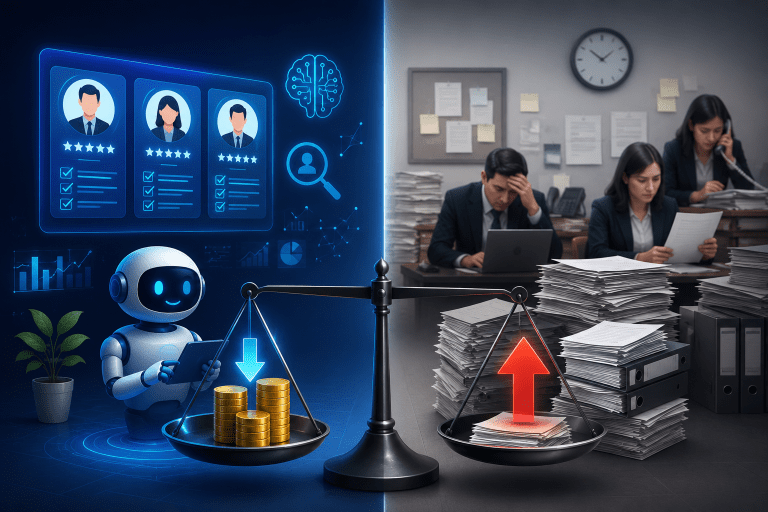
Traditional recruiting workflows were built for a slower labor market. In high volume hiring, those models break down fast. You see the symptoms every week.
Manual screening that drains time
Recruiters read resumes one by one. They flip between systems, copy details into spreadsheets, and juggle email threads. That manual process steals hours from relationship work that actually improves candidate quality.
Under pressure, teams move to shortcuts. They skim instead of assess. They lean on gut feel instead of structured criteria. Strong candidates slip through while weak matches move forward.
Inconsistent evaluations across hiring managers
Hiring managers use different definitions of quality. One manager values tenure, another values flexibility, another focuses on schedule. When each person creates their own rules, your hiring process becomes unpredictable.
This lack of standardization makes it hard to improve outcomes. You cannot fix what you cannot measure, and you cannot measure a process that changes from manager to manager.
Slow response times that lose candidates
Hourly and frontline talent moves fast. If your team takes days to screen and respond, candidates move on. Manual workflows often create gaps between application, screen, interview, and offer. Every delay becomes a chance for a competitor to step in.
Weak link between hiring decisions and retention
Traditional recruiting often stops tracking once a role is filled. You fill the req, move on, and only feel the impact when turnover surfaces later. Without a tight link between hiring inputs and retention outputs, you repeat the same patterns that lead to churn.
These challenges stack up. You spend more on sourcing, burn out recruiters, frustrate managers, and still miss your goals. AI hiring technology is not a gadget for this problem. It is a way to rebuild the system on data, speed, and repeatable decision logic.
How AI Is Transforming Talent Acquisition
AI talent acquisition shifts your function from reactive order-taking to proactive workforce building. It does this by embedding intelligence at each stage of the AI recruitment process.
From human bottlenecks to automated flow
Recruitment automation tools eliminate the mundane and routine tasks from your daily working schedule. Things such as screening questions, background checks, status updates, and interview scheduling gradually become automated workflows that operate silently in the background while your team concentrates on work of more value.
It is not a replacement for recruiters but rather a provision that leads them to have more time to consult with hiring managers, re-sharpen profiles, and help candidates through the process.
From resume keywords to predictive signal
Screening in the past was mainly based on the use of keywords and job titles. AI, powered recruiting solutions can do a lot more. They look into the patterns that are associated with performance and longevity in the workforce over time. Such a signal is often beyond the resume headline.
By analyzing your past hiring records, AI is capable of identifying the candidates who fit the profile of strong, long-tenured employees, even if their personal histories seem very different at first glance.
From one size fits all to tailored experiences
AI hiring tools facilitate changes in communication patterns that are quite flexible. For instance, you categorize the candidates based on their recruitment stages, their priorities, and the degree of their likelihood to accept the offer. Each of these segments is then given a levelled SmartTexting™ style communication through workflows, reminders, and scheduling options.
This customization is what matters most in your hiring process, as it significantly lowers turnover rate. Candidates are kept in the loop all the time, and through getting continuous guidance, they don’t feel like they are simply a number in an impersonal recruitment system.
From reactive reporting to live insight
Conventional analytics reports are historical. By the time you get that trend data, the issue is already there. With recruitment AI, you track your funnel health almost live. You can identify the stage at which the most valuable candidates drop out, find which source generates employees with better retention, and which manager takes more time in the process.
Such knowledge enables instant decisions on drawing the attention of qualified candidates by way of changing the job description, modifying the screening criteria, and the interview schedule. You adjust yourself to the change just in time to keep your hiring targets.
Traditional Recruiting vs AI Recruiting
The contrast between traditional recruiting vs AI recruiting becomes clear when you map each step.
Source and attract
Traditional recruiting pushes the same postings to the same boards and waits. Recruiters sift through whatever flows in. AI driven sourcing, such as SmartSource™, optimizes channels based on quality of hire and tenure outcomes. Spend flows toward sources that produce strong, stable talent.
Screen and shortlist
Volume forces quick and often inconsistent decisions. AI powered candidate selection tools like SmartMatch™ and SmartScore™automatically assess candidates against the agreed success profiles. The software lists candidates according to compatibility and likelihood of staying.
Recruiters are still the ones to make the final call. They just initially work from a list that is based on facts rather than conjecture.
Interview and select
Conventional methods of interviewing and hiring involve a lot of back and forth for schedules, communication through emails, and subjective opinions. AI tools for recruiting help to coordinate between participants, ask the same evaluation questions, and get all the feedback in one place. You get comparable data across candidates and locations.
Hire and retain
In a traditional model, once a role is filled, the file closes. AI recruiting ties each hire to performance and tenure data through tools such as SmartTenure™. When someone stays and performs, the system strengthens that hiring pattern. When someone leaves early, the data signals what to avoid in future decisions.
Over time, this loop transforms hiring quality, time to fill, and turnover cost. You stop repeating mistakes and start scaling what works.
Key Benefits of AI Powered Recruitment Solutions
You experience the effects in speed, quality, and cost when you introduce AI-powered recruitment solutions into your world.
Faster time to fill without losing fit
Delays between steps are eliminated by automated screening, scoring, and communication. Top candidates are assessed by the recruiters. Various hiring managers observe edited lists rather than queues. The team works fast and bases decisions on facts.
Higher quality of hire grounded in outcomes
Quality is not guessed on AI recruitment process tools. They get to know on your historical success and retention records. The model refines its vision of a strong hire in each position, region, and business unit over time.
This connection of the inputs and the outcomes elevates the base of all hiring classes.
Lower turnover and better retention
As your AI recruitment technology focuses on hiring those with more predicted tenure, churn decreases. The reduced number of early exits will result in less backfill, less training waste, and more reliable operations.
Less recruiter burnout and higher impact work
Recruitment automation tools deal with repetition. Recruiters channel their efforts into work that is strategic, like sharpening hiring criteria, creating relations with managers and training candidates. This transition enhances the health of the team and business contribution.
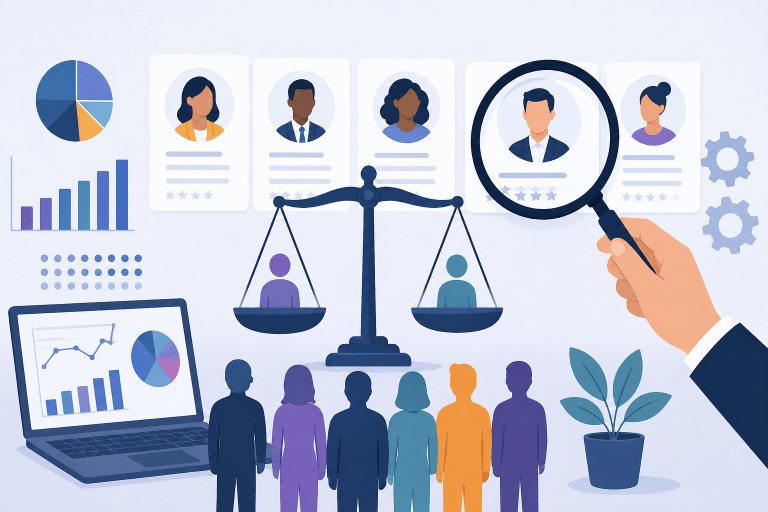
Stronger compliance and fairness
Standardized scoring criteria and well, defined processes help to minimize the element of human bias that is left unchecked. Of course, you will still require governance and audits, but AI provides you with an open, repeatable framework. The reasoning behind the movement of candidates up the funnel or their elimination becomes visible to you.
The advantages of AI in recruitment are not confined to the TA role. Leaders of operations experience a stable staffing. There are more evident links between labor cost and hiring decisions in the eyes of finance teams. Executives perceive an operation that operates on facts rather than stories.
Real-World Use Cases of AI in Enterprise Recruitment
High volume hiring environments are already undergoing transformation with the help of AI talent acquisition. This is the way it works within big companies.
Retail and hospitality seasonal hiring
Spikes in the seasons put a strain on all aspects of your process. The recruitment solutions powered by AI like Cadient SmartSuite™ spin up quicker. Previously trained models on past seasonal cohorts bring out candidates who are likely to perform well and remain with the company till the end of the season.
The SmartTexting™ style outreach ensures that the candidates are kept occupied throughout the crunch weeks. No show interviews are minimized through automated reminders. You achieve the goals on staffing with minimal overtime and last minute scurry.
High volume healthcare support roles
Healthcare organizations should have support teams that can cope with the stressful conditions. The AI employment technology can be used to analyze trends among long-term, high-performing workers in other positions like patient access, environmental services, and food service.
Recruiters are able to see which applicants replicate those patterns with SmartMatchtm and SmartScoretm. The screening streams give priority to the candidates who have higher chances of remaining and adjusting to the speed of the care environments.
Multi location quick service restaurants
Franchise and company owned locations tend to fight turnover and lack of applicants. The store managers benefit because recruitment automation tools allow them to balance between hiring and running the business. The automated screening questions sieve out blatant incompatibility without the manager even glancing at them.
SmartScreen™ and SmartTexting™ processes limit manual follow up. SmartTenure™ takes into consideration retention data at each store in real time, hence, the system can learn what will work in urban and suburban stores, weekdays and weekends heavy shift, etc.
Call centers and customer care hubs
AI recruitment process tools are used to identify candidates with profiles that match those of employees who are effective in high-volume call centres.
The SmartSuite™scoring and automation take the candidates through the application and to the seat in a high speed. Fewer empty stations and fewer classes are viewed as stable by managers.
Also Read: Talent Analytics vs HR Analytics: What’s the Difference?
Challenges and Limitations of AI Recruitment
Recruiting using AI is not magic. It brings its own guardrails and risks that you need to manage with intention.
Data quality and bias
AI recruitment technology gets to know you by past data. The model can be used to perpetuate bias in your past hiring patterns. When setting measures of success, you require good governance, auditing procedures and varied input.
Clear documentation, periodic reviews, and fairness testing matter as much as the algorithm itself.
Change management for recruiters and managers
Even in cases where AI is employed in recruitment solutions leads to better results, it needs behaviour change. The recruiters have to rely on the recommendations but use judgment. The managers will have to live with more formalized interview and selection systems.
The absence of effective communication and training makes AI a threat rather than a multiplier to teams.
Over reliance on scores
Scores help you prioritize, not replace human decision making. When the teams consider AI scores as a ruling point, you will be missing on context that is not within the data. A superior AI recruitment procedure retains the human input in the process to accommodate subtlety and exceptions.
Integration with existing systems
There are several active TA teams that already have to deal with various platforms. Bringing in new AI talent acquisition tools without a definite integration strategy generates additional noise. You require an actual platform that is compatible with your ATS, HRIS and background systems rather than more swivel chair work.
The target is a connected hiring engine that is clean and not an isolated tool.
Future of AI in Recruitment and Hiring Technology
AI in recruitment is still developing, but the trend is evident. Hiring will be increasingly towards more robust prediction and narrower feedback loop and more automation on the periphery, with human judgment in the core.
Deeper retention based prediction
The technology in AI hiring in the future will be biased even more towards retention indicators. Applications such as SmartTenure™ will inject more performance, interaction, and schedule information into models. The system will be able to predict not only who will accept, but who will remain and develop.
More personalized candidate engagement at scale
The SmartTexting™ style engines will be used to provide customized two way messaging that is aligned to the preferences of the candidates, type of job and stage. Your communication will reach thousands of candidates in a direct and timely way rather than a generic and slow one.
Unified hiring intelligence platforms
Point tools will be condensed to single solutions like Cadient SmartSuitetm, which will be in charge of the entire AI recruitment process. Starting with SmartSourcetm to SmartScreentm and SmartMatch™, your team will operate on a single intelligent layer, which presents the appropriate action at the appropriate moment.
Closer partnership between TA and operations
TA will be more aligned with operations as AI talent acquisition tools become increasingly more evident in their correlation of hiring decisions, turnover cost, and productivity. The discussion will no longer be about the number of hires but a question of what combination of hires will result in stable and efficient locations and a cohesive team.
The advantages of AI in the recruitment process will shift into the reality of operation. The successful companies will not regard AI as an ancillary system but view it as a fundamental hiring system.
To consider the opportunities of intelligence high volume hiring, end to end, consider Cadient SmartSuite™, SmartSource™, SmartMatch™, SmartScore™, SmartTenure™, SmartScreen™, and SmartTexting™. Discuss the construction of an AI hiring technology stack that lowers the turnover, time to fill, and enhances the quality of hire at Cadient.