

High-volume healthcare hiring does not give you a break. Roles stay open, overtime piles up, and leaders keep asking why staffing targets fall short. You feel the pressure from every side. Patients, clinicians, finance, and compliance all depend on your team getting hiring right, fast, and at scale.
Traditional high-volume recruiting tools were built for general hiring. Healthcare adds licensure, scheduling, compliance, union rules, and patient safety risk. Your hiring tech needs to meet that reality. AI healthcare hiring platforms give you a path out of reactive, manual work and into signal-driven hiring decisions tied to retention and quality.
You do not need more noise in your process. You need a system that filters signals at scale, flags risks before they hit the floor, and helps you move the right candidates from apply to start with confidence. That is where intelligent, predictive platforms built for healthcare come into play.
What Is Healthcare Hiring at Scale
Healthcare hiring at scale means you recruit, screen, select, and onboard volumes of clinical and non-clinical talent across multiple locations, shifts, and specialties, on a constant loop. You manage requisitions for nurses, CNAs, techs, environmental services, dietary, registration, and more, sometimes across hospitals, clinics, and long-term care in one portfolio.
Under that pressure, you cannot treat each req as a bespoke project. You need repeatable, data-driven workflows that maintain high throughput without compromising hiring standards. AI healthcare hiring platforms support this by aligning volume hiring to three core needs: speed, accuracy, and retention.
- Speed: Reduce friction from applying to accepted offer so you stop losing talent to faster competitors.
- Accuracy: Align candidates to role, shift, culture, and supervisor style using predictive signals, not gut feel.
- Retention: Use historical data to prioritize candidates who are more likely to stay and perform in your environment.
When you view hiring at scale through that lens, large-scale healthcare recruitment becomes an operations challenge, not a posting challenge. You need a platform that behaves like a highly disciplined operations system.
Also Read: Improving Offer Acceptance Rates With Data-Driven Hiring
Challenges in Scaling Healthcare Recruitment
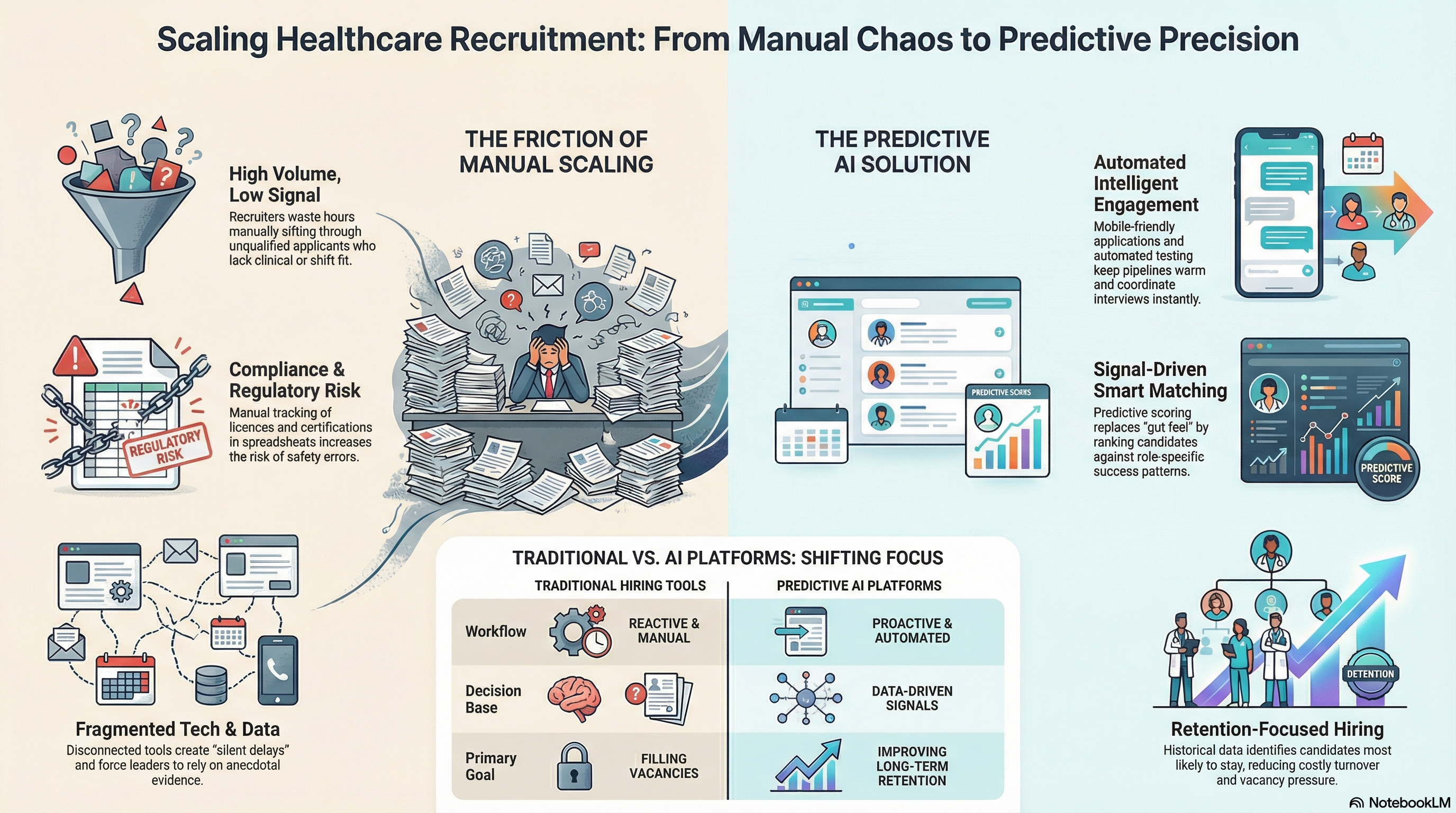
Healthcare recruiting leaders do not struggle because they lack effort. The system works against them. Traditional tools and habits create drag when you scale. You likely recognize several of these friction points.
High volume, low signal applicant flow
Posting roles across multiple boards brings in a flood of applicants. Many are unqualified or not a fit for your shifts or sites. Recruiters sift manually, reading resumes that say little about bedside behavior, resilience, or schedule reliability. AI recruitment for healthcare improves this by adding a structured, predictive signal before recruiters touch a requisition, but most teams still rely on manual review.
Shifts, schedules, and location complexity
Roles are not interchangeable. Nights in a busy urban ED differ from days in an outpatient clinic. Float pool rules differ from unit-based staffing. Large-scale healthcare recruitment fails when your process ignores these operational realities. Manual workflows often lose track of candidate shift preferences, commute tolerance, secondary locations, and license portability.
Licensure, compliance, and risk
You carry regulatory, legal, and patient safety risk with every hire. License checks, certifications, sanctions, vaccination records, and background screens all matter. If your system relies on spreadsheets and inboxes, errors will appear as volume grows. Automated healthcare hiring needs embedded checkpoints so compliance workflows are with the process, not in parallel email chains.
Fragmented tech and weak handoffs
Many healthcare organizations use an ATS for posting, a separate screening tool, manual interview scheduling, and standalone background checks. None of these speaks cleanly to each other. Recruiters spend time updating status updates and following up with hiring managers for feedback. This slows cycle time and confuses leadership reporting.
Reactive, anecdotal decisions
Leaders ask for faster time-to-fill and lower turnover, yet decisions still tilt toward gut feel. Hiring managers depend on short interviews and unstructured notes. Historical turnover sits in HRIS reports, not in a predictive model that guides decisions. Healthcare talent acquisition platforms need to tie each hiring decision to expected retention and performance, or your team will keep repeating costly patterns.
Also Read: How AI Improves Hiring Quality, Not Just Speed
How AI Platforms Enable Large-Scale Healthcare Hiring
AI healthcare hiring platforms approach these problems as data and workflow issues. The goal is not to add gimmicks. The goal is to make each decision more informed, more consistent, and faster, across thousands of candidates.
Turning raw applicants into ranked shortlists
In a predictive platform, applicants flow in through a modern, mobile-friendly application that collects structured information up front. SmartSource™ aligns sourcing campaigns to the roles and locations where you repeatedly struggle. SmartMatch™ and SmartScore™ then assess each candidate against the role qualifications, success patterns, shift and site requirements.
Recruiters get a ranked list for each req, rather than a daunting pile of resumes. They get a clear view of candidates who qualify at a baseline level, those who qualify at a high level of retention through SmartTenure™, and those who pose a risk. This reduces manual sorting and concentrates on the right candidates for large-scale healthcare hiring.
Automated, intelligent communication and scheduling
Automated healthcare hiring requires tight coordination with candidates who work irregular hours and different shifts. SmartTexting™ engages candidates through text, confirms interest, shares next steps, and coordinates scheduling. You keep your pipeline warm without manual check-ins.
Integrated scheduling links manager availability to candidate preferences. This cuts the lag between application and interview. You keep clinical leaders involved with minimal calendar work on their part. The platform keeps candidates informed so they do not accept competing offers while waiting on your process.
Embedded screening, background, and compliance
SmartScreen™ weaves screening into the hiring flow. Rather than handoffs from tools to spreadsheets, your team can start background checks, drug screens, and other required verifications within the same system. Recruiters get status visibility in one place, eliminating silent delays from missing paperwork or missed emails.
Compliance rules and document requirements align with each role and location. You reduce manual judgment calls and avoid inconsistent treatment of candidates. At scale, this protects you from risk and keeps throughput steady.
Predictive retention and quality focus
AI recruitment in healthcare reaches its full value when it links pre-hire signals to post-hire outcomes. SmartTenure™ draws on your own historical hiring and turnover data to highlight patterns. Instead of generic personality scores, you see which candidate profiles tend to stay and perform in your specific units, schedules, and leadership structures.
That insight feeds back into SmartScore™ and SmartMatch™. Candidates receive scores that reflect both fit for the job and likely retention. Recruiters and hiring managers share the same prediction, which reduces subjectivity in decision-making.
Key Benefits of Using AI for Healthcare Recruitment
When you adopt AI healthcare hiring platforms built for high-volume roles, you shift how your team spends time and how the business experiences hiring. The benefits show up across speed, quality, and cost.
Faster time to fill without rushed decisions
Automated screening, scoring, scheduling, and texting remove manual administrative work. Recruiters spend their time on conversations and decisions, not on sorting email. Roles move from open to accepted offers faster. At the same time, SmartScore™ and SmartTenure™ bring structured evidence into each decision, so faster does not mean sloppier.
Higher quality of hire tied to your environment
Healthcare recruitment using AI is centered on what success looks like in your system, not a generic model. By learning from your past data, the system identifies candidates with qualities and backgrounds similar to your successful employees. This minimizes errors in areas such as shift acceptance, speed, and teamwork.
Lower turnover and reduced vacancy pressure
Every regretted departure creates overtime, traveler spend, and patient experience risk. If your system emphasizes candidates with better predicted tenure, you minimize this hidden expense. With time, there will be fewer urgent backfills, which means your staffing and recruiting workload will be more stable.
Cleaner data and better workforce planning
Healthcare talent acquisition platforms with predictive analytics provide leaders with accurate, timely insight. You see where candidates leak out of the funnel, which facilities struggle most, which hiring managers drive stronger retention, and which sourcing channels produce durable talent.
With integrated data, your team moves workforce planning from guesswork to evidence. You defend headcount and technology investments using real hiring and retention outcomes instead of anecdotes.
Stronger candidate experience for frontline talent
Frontline healthcare workers expect a simple, mobile, transparent hiring process. Long forms, broken portals, and silence between steps push them toward other employers. Automated healthcare hiring with SmartTexting™ keeps them informed and respected. Clear expectations and quick responses signal that your system values their time, which also improves acceptance rates.
Best Practices for Implementing AI in Healthcare Hiring
Fixing a broken process with AI alone is not possible. There is a need for design and alignment between HR, operations, and clinical leadership. The above best practices will enable you to implement AI-powered healthcare hiring platforms that last and give you results.
Start with your highest impact roles and locations
Mass healthcare recruitment encompasses a broad spectrum of activities. Start by finding where the pain of recruitment and turnover is. Focus on areas and positions where the effect of the vacancy has the greatest influence on patient outcomes or business success. Apply SmartSuite™ on such areas first so that key leaders can experience the benefit.
Align selection profiles to real performance and tenure
Do not let generic job descriptions drive your predictive models. Partner with operations and clinical leaders to define what success looks like in specific units and shifts. Feed historical performance and tenure data into SmartTenure™, so SmartScore™ reflects your reality, not theory from outside your walls.
Redesign workflows, do not simply overlay AI
If your existing workflow involves multiple applications and human approvals, take a step back before you begin the implementation. Map out the future state. Where does the candidate come in? Where do SmartMatch™ and SmartScore™ evaluate them? Where does SmartScreen™ fire? Which steps go to SmartTexting™, and which remain human?
Train recruiters and hiring managers on decisions, not features
Your team does not need a technical lecture. They need to understand how predictive scores and recommendations can help improve decisions. Teach recruiters how to understand SmartScore™ and SmartTenure™ in context. Train managers on how to use ranked candidate slates and structured interview guides based on the model.
Make it clear that AI-powered healthcare recruitment platforms are there to support their decision. The goal is consistent, data-driven hiring, not relying solely on scores.
Monitor outcomes and adjust models over time
Healthcare recruitment using AI should never be fully automated. Work with your vendor to regularly assess hiring and retention results. Confirm that the candidates suggested actually perform and stay with your organization as expected. Your models and workflow rules should be adjusted through SmartSuite™ as necessary when there are changes to your service lines, your leadership, or your market.
Protect fairness, compliance, and transparency
A larger scale hiring process for healthcare must provide equal opportunity to all candidates. Work collaboratively with compliance and legal specialists to review both data usage and recommend outcomes. Communicate with candidates clearly and in a fair manner. Proper documentation of the selection of predictive variables and their connection to job relevance must be maintained.
Conclusion
High-volume healthcare hiring will not get simpler on its own. Labor shortages, shifting care models, and cost pressures will continue to mount. Manual, fragmented recruiting systems break under that load. You need a smarter, integrated approach that respects both speed and fit.
AI healthcare hiring platforms give you a way to run large-scale healthcare recruitment with discipline. They turn raw applicant noise into a clear signal, tie decisions to predicted retention and performance, and free your team from low-value tasks. When you pair predictive tools with strong process design, you protect patient care, stabilize staffing, and defend your HR strategy with data.
Cadient built SmartSuite™ for intelligent high-volume hiring in environments like yours. SmartSource™, SmartMatch™, SmartScore™, SmartTenure™, SmartScreen™, and SmartTexting™ work together as a single system, so you move from guesswork to signal across every requisition.
If you are ready to align your healthcare talent acquisition platforms with the realities of frontline staffing, talk with Cadient about how predictive hiring can change your next hiring cycle. Schedule a conversation with Cadient and see how intelligent high-volume hiring can support your teams.
FAQs
What are AI healthcare hiring platforms?
Platforms that offer AI-based services to the healthcare industry help deliver predictive hiring solutions to improve the number of candidates hired. The platforms use predictive modeling, automation, and data analytics, enabling healthcare employers to scale hiring. They assess each candidate against a predetermined set of Role Requirements and Key Performance Indicators (KPIs), helping recruiters and managers make informed decisions about whether to hire them.
How do AI platforms support large-scale healthcare recruitment?
By automating various aspects of the recruitment process, such as screening, shortlisting, communicating with candidates, and scheduling, AI platforms break down a huge number of tasks into one continuous recruitment process. This means that the metrics of every candidate, including test scores and background checks, are tracked in one place. Hiring managers concentrate on high-touch recruitment activities, and AI platforms are held responsible for the efficiency of the recruitment process.
Is AI recruitment for healthcare fair to candidates?
With appropriate design and effective management, AI recruitment systems in the healthcare sector can improve equity by using objective criteria, reducing human bias, and providing transparency into the rationale for each decision. However, this effort needs to be well-managed, thoroughly analyzed, and clearly aligned with model inputs and job requirements.
What data do healthcare talent acquisition platforms use?
Healthcare talent acquisition platforms combine job data, candidate information, and your historical hiring and retention outcomes. They examine which profiles tend to remain and perform in specific roles and shifts, then use those patterns to inform future recommendations. High-quality platforms also uphold high standards of privacy and security for all data.
How do I start with automated healthcare hiring in my organization?
Begin with knowledge of your current high-volume job types, problems, and technology infrastructure. Also, identify the business units and geographies that have the most extreme vacancy pressure and employee turnover. Collaborate with a partner such as Cadient, who has experience in intelligent, predictive, high-volume hiring.
