You feel the pressure to fill roles fast. Store managers want coverage. Operations wants schedules locked. Finance wants labor aligned with demand. Every day a role sits open, the pressure grows.
So your team moves faster. More sourcing. More screening. More interviews are packed into each week. Productivity increases, but quality remains flat. Turnover does not move. Managers keep saying the same thing. “We need better people.”
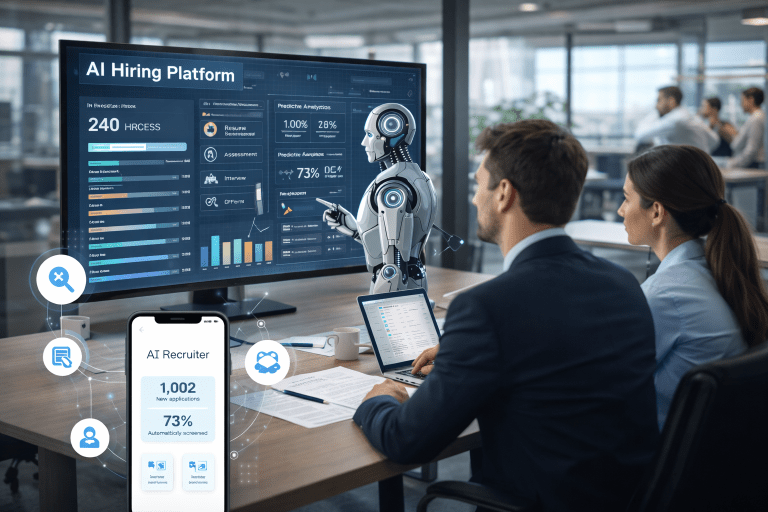
AI for improving hiring quality gives you a way out of this trap. The point is not speed alone. The point is smarter decisions at scale. The right people in the right roles who stay and perform.
What Is Hiring Quality
Before you evaluate tools, you need a clear definition of hiring quality. If you do not define it, you cannot improve it.
Hiring quality in practical terms
Hiring quality is not a gut feel. It is how well each new hire:
- Meets or exceeds performance expectations for the role
- Stays long enough to offset hiring and training costs
- Fits the work, schedule, and culture so managers trust them
- Supports customer experience instead of hurting it
For high-volume environments, hiring quality shows up in a few core metrics. Lower early turnover. Better attendance. Fewer no-shows. Higher manager satisfaction with new hires. More stable coverage.
Why your current view of quality stays fuzzy
Most teams still use indirect signals. Hiring manager surveys. Anecdotes from the field. Occasional performance reviews. These inputs remain fragmented, so quality becomes a story rather than a measurable outcome.
AI-driven recruitment quality needs something sharper. Clear definitions tied to data. Examples:
- Did the employee stay past the risk window for early attrition
- Did they meet baseline productivity by a set day on the job
- Did they receive avoidable write-ups or attendance hits
When you align with this definition, AI for improving hiring quality has a solid foundation to learn from. You move from intuition to signal.
Limitations of Speed-Focused Recruitment
High-volume hiring teams often celebrate speed. Time to contact. Time to schedule. Time to offer. On their own, these metrics hide risk.
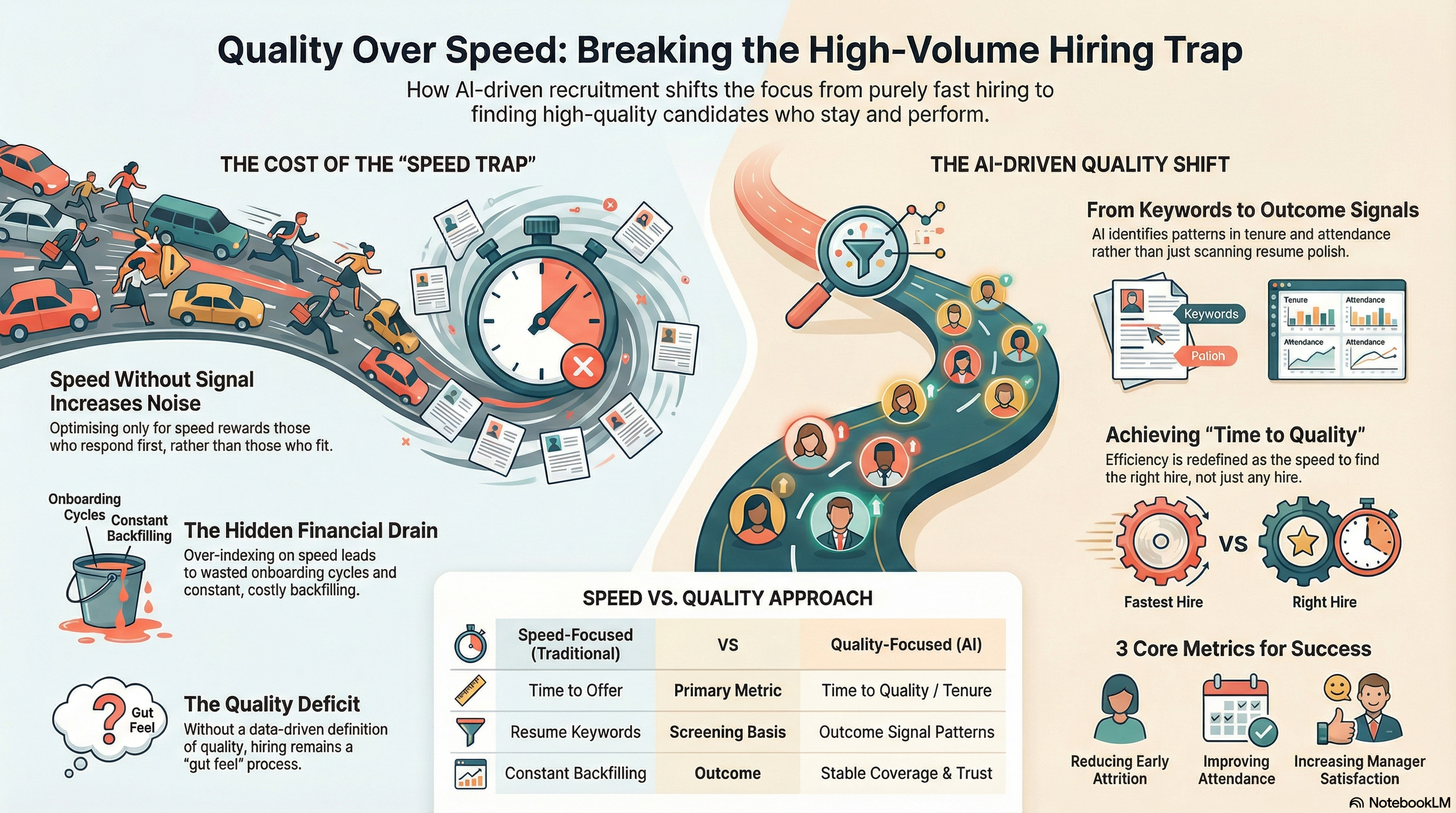
Speed without signal increases noise
If your process only optimizes for speed, you reward whoever responds first. You reward whoever accepts any schedule. You reward anyone who clicks through an application the fastest.
That pattern does not protect you from a poor fit. It ignores:
- Schedule alignment with store or site needs
- Distance from worksite and commute friction
- Past work patterns that predict stay or churn
- Soft skills tied to customer-facing roles
Speed alone turns into a volume game. You pour more applicants into the top of the funnel and hope enough of them stick.
The hidden cost of speed-only thinking
When you over-index on speed, you pay in other places. You feel it in:
- Higher early-stage attrition and constant backfilling
- Manager burnout from retraining and low trust in new hires
- Unstable schedules that hit customer experience
- Labor spend wasted on repeated onboarding cycles
Quality-focused hiring automation helps you maintain speed while filtering for fit. AI to improve hiring quality helps you avoid paying for the same role repeatedly.
How AI Enhances Hiring Quality
AI enters the picture when you want both speed and accuracy. No more tasks for recruiters. Better signal in the moments that drive outcomes.
From resume keywords to outcome signals
Traditional systems focus on keywords and simple filters. Years of experience. Education level. Previous titles. Those rules do not align with how hourly or frontline work functions.
Intelligent recruitment solutions focus on outcomes instead:
- Who stayed in similar roles under similar conditions
- Who performed well in matching schedules and locations
- Which application patterns are linked to better tenure
AI for improving hiring quality uses historical signals, not to lock in bias, but to highlight patterns that predict performance and retention. You move beyond surface-level screening.
Enhancing candidate selection with AI
For each role, AI can score candidates on likely fit using your own definitions of quality. Enhancing candidate selection with AI means:
- Ranking applicants based on fit, not resume polish
- Giving recruiters shortlists that align with quality, not guesswork
- Reducing time wasted on low probability interviews
- Highlighting hidden candidates who match proven high performers
When you use AI-driven recruitment quality tools, your teams stop treating all applicants the same. You invest time in people who match the role and are more likely to stay.
AI as a guide for hiring managers
Store and site managers often make decisions under time pressure. They juggle schedules, operations, and hiring. Guidance helps.
AI-driven shortlists and scores keep choice in the manager’s hands, but surface a clear signal. Which candidate likely aligns with tenure? Which aligns with attendance. Which aligns to customer facing success. The manager gains context without more manual analysis.
Key Benefits of AI-Driven Quality Hiring
AI for improving hiring quality should not feel like theory. It should appear in the outcomes you track and defend to leadership.
Stronger retention and lower churn
When your model focuses on quality outcomes, your decisions shift. You stop rewarding speed alone. You prioritize signals tied to stay, performance, and attendance.
Over time, this reduces early exits and the need for constant rehiring. You protect training investment. You stabilize coverage. You remove noise from your hiring funnel.
Better alignment between TA and operations
Operations leaders lose trust when hiring feels random. One location gets reliable people. Another struggle. AI-driven recruitment quality tools help you drive consistent standards.
Shared metrics, such as quality of hire and early tenure, provide a common language. Everyone sees how AI supports quality-focused hiring automation, not a black box system. That clarity improves partnership.
Faster time to quality, not only time to hire
Speed still matters. The point is to focus on the right version of speed. With better ranking and screening, your team contacts high-fit candidates earlier in the process.
You shorten the time to first shift for the right hire. You lower abandonment in the funnel. You provide experience for candidates and managers.
More consistent and fair decisions
Human decisions drift. Time of day. Stress level. Personal bias. Lack of context. These factors create inconsistent outcomes. AI for improving hiring quality supports more even treatment.
When every candidate goes through the same scoring process, hiring teams get a shared view of fit. You still apply human judgment, but you start from a consistent baseline.
Best Practices for Implementing AI in Recruitment
Intelligent recruitment solutions only help if you implement them with clarity. The goal is simple. Better hiring decisions tied to measurable outcomes.
Start with your definition of quality
Before you turn on any model, lock your definitions. You need agreement on what success looks like by role type. Examples for frontline or hourly roles:
- Retention beyond the early risk window
- Attendance above a specific threshold
- Completion of training milestones
- Manager rating after a set period
Use these definitions to guide the model and the metrics you track. AI-driven recruitment quality depends on this foundation.
Use data-driven hiring decisions, not intuition
Your ATS and HRIS hold more signals than you think. Past hires, tenure, corrective actions, and performance trends are all relevant. The right system will connect all these to the hiring process.
Data-driven hiring decisions look like:
- Identification of sources from which hires are of a higher quality
- See which screening questions predict retention
- Knowing the locations that need different profiles
- Improving your process based on results rather than opinions
Quality-centric hiring automation should simply highlight these trends to you without requiring extra work on your team.
Keep humans in the decision loop
AI should assist your recruiters and managers, not replace them. You still need their local knowledge, their understanding of local conditions, and their final say.
Align your process so AI:
- Scores and ranks candidates on defined quality outcomes
- Flags high-risk hires for extra review
- Strong fits to accelerate contacts
- Provides hiring managers with clear and simple guidance
Prioritize transparency and compliance
When you are using AI within hiring processes for better hiring quality, you require effective communication, where your internal teams and candidates understand:
- What parts of the process employ AI
- What signals the system evaluates
- How people still make the final decisions
Collaborate with service providers that also support the compliant implementation of AI, auditable models, and documentation, which will safeguard not only your brand, but also your applicants and teams themselves.
Conclusion
Traditional high-volume hiring systems reward speed at the expense of outcomes. Your team moves fast, yet turnover stays high. Managers keep asking for “better” people without a clear definition of “better.”
AI for improving hiring quality provides the structure and signals you need. You focus on tenure, performance, and fit. You support recruiters and managers with clear guidance. You match speed with accuracy, not chaos.
Cadient builds intelligent recruitment solutions for employers who want this shift. SmartSuite™, SmartSource™, SmartMatch™, SmartScore™, SmartTenure™, SmartScreen™, and SmartTexting™ align around one goal. Quality-focused hiring automation that supports real people, in real operations, at high volume.
If you are ready to move past speed-only hiring and align quality with every decision, explore how Cadient can support your team.
FAQs
How does AI improve hiring quality compared to traditional screening?
Traditional screening focuses on resumes and simple filters. AI for improving hiring quality focuses on outcomes like tenure, attendance, and performance. The system learns from your past hires and uses those patterns to score new candidates. Recruiters and managers see a ranked list based on fit, not guesswork.
Will AI replace recruiters or hiring managers?
No, AI is there to support you and handle the heavy lifting of identifying patterns and repetitive tasks. You, as a recruiter, remain in charge. The AI system simply directs you towards the candidates that have met the quality that you were looking for.
How do we keep AI fair for all candidates?
Fair AI is built on sound design principles, transparency, and monitoring. Find a vendor that facilitates auditing, has transparent documentation, and also lends itself to compliance reviews. Ensure your inputs are consistent to support equitable, quality-driven decisions.
What data do we need to start using AI-driven recruitment quality tools?
You need hiring history tied to outcomes. That includes start dates, exit dates, location, role, schedules, and basic performance or attendance data. The cleaner and more complete your data, the stronger your AI insights. A partner like Cadient helps you connect these sources and focus on the most important fields.
How quickly will we see impact from AI for improving hiring quality?
Timelines depend on your volume and data quality, but many organizations start to see a clearer signal and better shortlists early in adoption. Over time, as the system learns from more outcomes, you see stronger alignment between hiring decisions and retention, manager satisfaction, and overall quality of hire.