By Abhishek Patel · March 17, 2026
Your hiring team isn’t low on effort. It’s simply that the traditional ways of working keep slowing down everything that they do. The use of spreadsheets, manual screening, incompatible tools, and decisions made by intuition create difficulties at every step.
A recruitment automation platform substitutes that friction for signal. You proceed more quickly, make more accurate decisions, and fill your hourly and high-volume roles with people who stay.
What Is a Recruitment Automation Platform?
A recruitment automation platform is a tool that organizes and automates the main parts of your recruiting process. It links sourcing, screening, assessments, interviewing, and offers into a single efficient flow. You prevent manual work, reduce the necessity of repeatedly entering data, and transform your hiring policies into a uniform, automated hiring process.
Conventional applicant tracking systems store candidate information. A genuine recruitment automation platform uses that information to decide what to do next. It evaluates candidates, directs them to the appropriate step, sends messages at the correct times, and highlights the candidates who are very likely to perform well and stay. What you get is recruitment workflow automation instead of a static database.
For high volume and hourly hiring, this change is significant. You constantly have open positions, deal with seasonal spikes, and face a tight labor market. Manual decision-making quickly becomes inefficient. A platform created for smart high-volume hiring helps your recruiters and hiring managers concentrate on interactions rather than paperwork.
Cadient SmartSuite™ belongs to this kind of platform. It is designed to focus on predictive hiring and retention in situations with a lot of hiring. SmartSource™, SmartMatch™, SmartScore™, SmartTenure™, SmartScreen™, and SmartTexting™ help you link your automated hiring process to the results that can be measured, such as turnover cost, time to fill, and quality of hire.
Key Features of Recruitment Automation Software
Recruitment automation software provides a range of essential features that radically transform a completely manual process into an orderly, repeatable system. These features eliminate the lowest value work, enhance the level of consistency, and reveal the concealed inefficiencies in your overall hiring process.
Automated Sourcing And Distribution
You spend time when you have to manually post and distribute each role.
Powerful hiring automation tools help centralize job creation and from one place push postings across boards, social channels, and your career site.
Rules define the location and timing of the appearance of each role, so your team does not have to look for logins and templates.
When using SmartSource™, you are able to align your sourcing rules with the historical performance of the sources.
The system contacts spend and effort on the hires that come from the sources that produce the hires that stay, not the sources that generate noise.
Screening, Scoring, And Shortlisting
Manually reading resumes eats up recruiter capacity and brings in bias. Recruitment automation software swaps subjective screen, outs for structured scoring. You set job, relevant factors, like experience, availability patterns, and major skills. The platform applies these guidelines, along with the record of your own hires, to generate for each candidate SmartScore™ type rankings.
Recruiters get a neat shortlist. The best matches come up first, and auto disposal rules take the obvious mismatches out of the funnel. This automated recruitment workflow step maintains a stable quality level and releases recruiters from doing the same filtering over and over again.
Predictive Retention Signals
Just aiming to hire faster only results in higher turnover expenses. A recruitment automation platform links the selection process with retention results. Models like SmartTenure™ leverage your past data to identify which candidates are most likely to stay and do well in each job and location.
It evaluates the likelihood of tenure for every candidate. Hiring managers and recruiters have a clear understanding of immediate fit and probable retention. This directs the offer round to those who fit your culture and working hours, not only based on their qualifications.
Interview Scheduling And Coordination
Email back and forth and chasing by phone only extend cycle times. Todays hiring automation tools come with features such as automated scheduling. Candidates pick from real-time calendar availability.
Emails with confirmations and reminders are sent automatically. When cancellations and reschedules happen, calendars get updated without the recruiter having to get involved.
With this option, you get less time between steps and the candidate experience is safeguarded. Your team sets the guidelines and determines availability; however, the platform drives the process forward without you having to keep manually following up.
Integrated Background Screening And Workflows
Background checks are a frequent source of unexpected delays. Recruitment automation software with built-in screening, such as SmartScreen™, can help minimize these delays. Background steps are initiated automatically based on predetermined rules as soon as a candidate is at the offer stage. The updates on the status are shown within the same system, so recruiters are not handling separate portals and spreadsheets.
Such integration makes your automated hiring process run smoothly from offer to start date, with fewer surprises and less manual follow-up.
Text And Candidate Communication
Candidates looking for hourly work or in large quantities tend to reply quicker if you text them instead of emailing. Features similar to SmartTexting™ allow you to send personalized, yet automated, messages for significant moments.
For instance, you might thank new applicants, remind candidates of a scheduled interview, request missing information, and follow up on offers.
Every single text message is regulated by timing, content, and trigger criteria. Recruiters continue to directly message candidates in case it is necessary, but the platform takes on the majority of standard communications work. Candidates get to know what’s going on, while your team is less occupied with following up for responses.
Analytics, Audits, And Compliance Controls
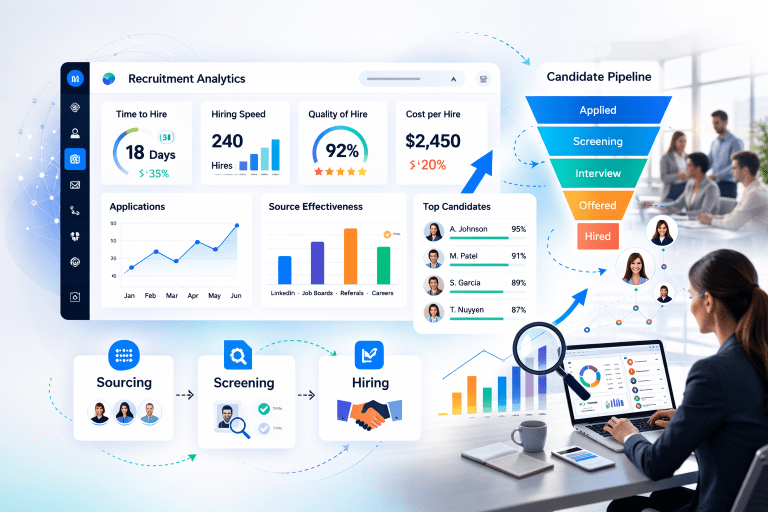
A recruitment automation platform should be able to demonstrate the effectiveness of each component of your funnel. For example, you monitor the time spent in a stage, the conversion rate by source, hiring manager performance, and retention by requisition and location. Clear analytics help identify the points of friction in the process. You will be able to pinpoint exactly where drop-offs have occurred and, consequently, which areas of the recruitment process, if optimized, will yield the most benefit.
Compliance controls and audit trails are equally important. Automated workflows provide for consistent, fair decisions that are in accordance with your policies. You get the insight into the actions that each person took at every stage, which is a safeguard for both the candidates and your company.
Also Read: High Volume Hiring Platform: How It Streamlines Mass Recruitment
How Recruitment Automation Improves Hiring Efficiency
Efficiency in hiring isn’t about increased effort. It’s about cutting down on waste. Recruitment automation software brings such tangible and measurable improvements to efficiency that your team can actually feel them every day.
Shorter Time To Screen And Prioritize
Without automation, recruiters manual screening keeps recruiters in a reactive mode only. With automated scoring like SmartMatch™ and SmartScore™, the platform takes in the applications and ranks them based on the suitability of the role and the potential for retention. Recruiters begin their day with a perfectly sorted list of candidates who are most deserving of their attention.
Such a move shortens the time that has to be wasted between the submission of an application and the first contact with the applicant. You can grab the attention of the best candidates before they take up other offers. Also, you minimize the delay of the hiring process due to automation, as the platform keeps processing the new applications in the background at all times.
Reduced Back And Forth With Candidates
Interview scheduling, missing data, and status checks cause excessive back and forth. Automated workflows and SmartTexting™ features help eliminate those gaps. Candidates self-schedule, receive reminders, and get nudges when they stall at a step. Recruiters handle exceptions, not every interaction.
This change frees up calendars and gives a predictable flow of interviews. Hiring managers find more qualified candidates in each block, instead of scattered, last-minute scheduling.
Aligned Recruiter And Hiring Manager Effort
If your process depends on email and spreadsheets, each hiring manager comes up with their own version of your workflow. That disintegration of the process destroys productivity. A recruitment automation platform standardizes the main steps, while still allowing role-specific configuration.
Recruiters and managers work from the same dashboards, candidate profiles, and scorecards. Everyone gets the same signals on fit and projected tenure. You eliminate cyclical discussions on basic requirements and turn those conversations into genuine tradeoffs, such as speed against fit for a certain location.
Cleaner Data And Fewer Manual Errors
Each manual handoff carries the risk that data is miskeyed, notes are lost, or steps are missed. Automation of recruitment workflows binds each stage together, so that information travels along with the candidate. Offer information, shift availability, and assessment results all remain in a single record.
This safeguards the candidate experience and lowers the amount of work done twice. You dont make the candidate answer the same questions multiple times. You also reduce your compliance risk since the required steps are triggered in the correct sequence every time.
Faster Ramp For New Recruiters
New recruiters have a hard time most of the time understanding the unspoken rules of the team. An automated hiring process puts those rules in the system. New hires get guided workflows, use standard scorecards, and receive prompts for every action that is required.
You are relieved from the burdensome manual training and are able to focus more on coaching people in quality conversations and relationship building. Productivity ramps faster, and the performance across the team becomes more consistent.
Also Read: Best High-Volume Hiring Strategies for Enterprises
Benefits of Recruitment Automation for Enterprises
Enterprise hiring teams are pressured from various sides. You have to accommodate a multitude of locations, changing labor pools, and strict compliance requirements. Recruitment automation software is your weapon in the battle against the convoluted situation while enabling local operations to be adaptable.
Scalable High Volume Hiring
Seasonal peaks and new store openings put pressure on the manual processes. By using automation, you can increase volume without a proportional increase in effort. Rules govern sourcing and screening for each location. SmartSource™ directs expenditure to those channels that yield hires with a higher retention rate. SmartScore™ and SmartTenure™ rank candidates who have the potential to succeed.
Recruiters act as supervisors and only step in when their judgment is required, for instance, with complex roles or in critical markets. The routine tasks are done by automation, so you can maintain your service levels even if there is a sudden increase in requisitions.
Lower Turnover Cost
Turnover costs accumulate quickly and too much employee turnover can shake up both labor budgets and operations. An AI recruitment automation featuring retention prediction can help selection of a high fidelity hire by deciding the candidate with whom the strongest fit factors have been identified. Hence, you make hiring decisions that are in accordance with the success patterns that are known for each role, shift, and manager.
As the recruitment process gets refined through continuous product development, the tendency to churn is diminishing. Backfilling staff will no longer be a regular concern when you save your training expenditures. Store leaders and operations teams witness the effect of their choices through more stable staffing levels and less time spent recruiting instead of running the business.
Consistent Candidate Experience Across Brands And Regions
Major enterprises generally have difficulty in maintaining a consistent candidate experience. Each locale follows its own interpretation of the process, which results in communication disparities and ambiguity in expectations. A recruitment automation platform ensures the standard communication touchpoints and timing are adhered to and it also allows for localized messaging where necessary.
Across your entire company, candidates get a clear indication of what to expect next, receive updates on time, and the whole process is predictable. Such uniformity not only reinforces your employer brand but also aids in recruiting applicants into employees, even when the labor market is tight.
Better Insight For Talent And Operations Leaders
Talent acquisition leaders require more than just the total number of applicants. Recruitment automation software brings up actionable statistics. You get to know where candidates drop out, which locations have the most difficulty, and what the average time in each stage is. Plus, you understand how predictive scores link to retention and performance.
Such information directs the way money is spent. Based on just the data and not on speculation, you adjust the sourcing, coaching, and other steps in the pipeline. Operations leaders get the message that hiring teams are not only delivering the headcount but also improving the workforce stability.
Support For Complex Workforces, Including eCommerce And Retail
The enterprises combining retail, eCommerce, distribution, and contact center roles internally have different hiring patterns. Recruitment automation platforms such as Cadient SmartSuite™ can easily help different workflow needs be mapped according to role type while keeping the common data model intact.
Preparing different rules for warehouse versus customer, facing roles is just one way of managing without going for a full, on-system separation. This mixture of global structure and local flexibility is a major recruitment automation benefit at the enterprise level.
AI Recruitment Automation vs Traditional Hiring
Hiring in the old-fashioned way depends on doing steps manually, leaving the decision up to a single person’s judgment, and following fixed rules. Over time, AI recruiting automation incorporates your historical data and the latest results to constantly fine, tune the decision-making process. Differences are evident in faster speed, better quality, and higher retention.
From Gut Feel To Data-Driven Selection
Traditionally, recruiters and hiring managers go through the process of putting candidates on a scale after only seeing their resumes and having a very brief talk. Bias and inconsistency can easily sneak in. AI, powered tools like SmartMatch™ and SmartScore™ consider both structured and unstructured candidate data and compare those to the indicators of success they already know.
The result is a list of candidates ranked based on their scores. Recruiters can still rely on their judgment, but it’s done after getting the first input from the objective signal. This not only minimizes differences in various locations but also changes the focus of the discussion from who looks good on paper to who fits the patterns of proven success.
From Static Rules To Learning Systems
Conventional hiring processes implement predetermined criteria and knockout questions. Such rules hardly ever get altered, even though job roles change. AI recruitment automation makes new hire performance predictions and adjusts them when it gets new hire data.
If candidates of a certain type consistently perform well or stay longer, the system picks up the pattern.
This closed loop enables recruitment process optimization on a continual basis. You adjust without manually updating the rules in numerous locations. The system learns, and your decisions get better through time.
From One Size Fits All To Context Aware Decisions
In traditional hiring, the same criteria are usually applied to all the markets. AI-powered tools are aware that the performance patterns may vary from one location, manager, or shift to another. Models such as SmartTenure™ can make retention predictions fluctuate according to different local histories.
A candidate who seems average at a national level might turn out to be a good fit for a particular store with a certain type of leadership. AI recruitment automation recognizes such details and thus helps you place people where they have the highest probability of succeeding.
From Manual Chasing To Automated Flow
In the past, hiring heavily depended on recruiters to drive each stage forward. AI-driven recruitment automation software, however, allows the hiring process to stay on track in the background.
SmartTexting™ prompts candidates. Scheduling tools automatically organize calendars. SmartScreen™ initiates the background checks at the appropriate time.
Recruiters are left with decision-making and relationship-building, rather than endless follow-up activities. This is simply one of the most evident advantages that the recruitment automation system can offer, particularly when you are dealing with large volumes of work.
How to Choose the Right Recruitment Automation Platform
The right platform has to be suitable for your hiring volume, the mixture of your workforce, and your retention goals. Besides that, it should be capable of integrating with your existing HR systems and be in line with how your operators work. Just a checklist won’t be enough to save you. You should challenge the actual workflows against your daily reality.
Start With Your Hiring Outcomes
Before looking at the features, specify the outcomes that you require. Among the examples are: lowering turnover cost in particular roles, shortening the time from application to offer, increasing interview show rates, or offering a uniform candidate experience across different regions. Employ these aims to sift through different vendors.
A platform that is set up only for applicant volume will not be of any help to you if your genuine concern is retention. Consider recruitment automation software that connects AI models and workflows directly to retention and quality of hire, as well as to speed.
Evaluate Fit For High Volume And Hourly Roles
One of the main differences between systems supporting professional hiring and hourly hiring is that the former can do more than the latter. If your business is retail, eCommerce, hospitality, healthcare support, or distribution, your requirements are different. You need powerful mobile experiences, text, based communication, and quick decision cycles.
Confirm that the platform supports short applications, automated screening, and the level of outreach that comes with SmartTexting. Your recruiters and store leaders should be able to change an applicant to an interview within a few hours, not weeks. Hire time reduction through automation should be the main goal that guides your assessment.
Review Predictive Models With Your Data
It only makes sense for AI recruitment automation to add value if the models correspond to your employees. Request vendors to show how predictive scores, such as SmartScore™ and SmartTenure™, are modified based on your data. You want to be able to see through to the signals that the model uses and how these signals correspond to your results.
Make sure the platform provides features for audits, compliance reviews, and understandable explanations of the ranking. This is a way of creating confidence in recruiters, hiring managers, and legal teams.
Check Integration And Workflow Flexibility
Your recruitment automation system should be able to integrate with HRIS, payroll, and learning tools without the need for complicated workarounds. See how the offer, onboarding, and new hire data are flowing through the system. A robust integration will eliminate the need for manual data entry and ensure the accuracy of the data. In the meantime, examine the workflow flexibility. You want to have standardization, especially when it comes to compliance and insight but at the same time, configuration to different roles. Enterprise hiring automation software should be capable of doing both without a hitch.
Test With Recruiters And Operators, Not Only TA Leaders
Talent acquisition heads generally evaluate the features from a strategic standpoint. Recruiters, store managers, and frontline supervisors are the ones who actually implement the daily workflow. Get their involvement in demos and pilots. See how quickly they go from requisition to offer using the system. Give attention to clicks, page loading, and navigation. The real recruitment process optimization is when the platform is so in tune with their work that it even feels like a part of it, not an additional one.
Measure Impact In A Controlled Pilot
Prior to a wide implementation, conduct a controlled trial in a few locations or business lines. Measure time to hire, offer acceptance, interview show rates, and early tenure. Check the results against those of the locations with similar changes but using traditional hiring methods.
Leverage these results to fine, tune the configuration and make a case for a larger adoption. Recruiting workflow automation should demonstrate visible, measurable benefits before you extend it to the whole enterprise.
In case you want to ditch manual hiring friction and replace it with a data-driven, automated hiring process that supports the speed, accuracy, and retention of, look into how Cadient SmartSuite™, including SmartSource™, SmartMatch™, SmartScore™, SmartTenure™, SmartScreen™, and SmartTexting™, meets your high-volume hiring needs. Discuss with Cadient about intelligent recruitment automation and find out how your hiring operation runs when the signal replaces the guesswork.