By Akshita Kohli · February 22, 2026
You feel the pressure from every direction in hiring. Operations leaders want roles filled fast. Finance wants turnover reduced. Store and site leaders want dependable people on the floor. Traditional reports do not help you decide who to hire next week or next quarter.
Recruitment analytics software gives you a signal instead of noise. It pulls data from every step of your hiring funnel, then turns it into clear guidance on who to hire, where to source, and how to keep people longer.
What Is Recruitment Analytics Software?
Recruitment analytics software is a system that collects, organizes, and analyzes hiring data so you can make evidence-based decisions, not instinct. It looks across your hiring funnel, from applicant volume to long-term tenure, and helps you see which actions lead to better hires.
A strong recruitment analytics platform connects to your applicant tracking, assessments, background screening, and onboarding tools. It consolidates data into a single source of truth. You get a real view of hiring performance by brand, location, role, recruiter, and source.
Unlike simple reporting tools, hiring analytics software focuses on patterns over time. It links hiring decisions to outcomes such as retention and performance. You go from tracking activities to predicting results.
How Recruitment Analytics Software Works
The basic steps followed when using recruitment analytics software are:
First, it ingests data. The recruitment analytics platform can connect with your ATS, scheduling platforms, background screening platforms, texting platforms, and HRIS. The data ingested can include applications, interviews, offers, hires, and employment outcomes.
Secondly, it cleans and standardizes the data. Data is typically collected differently in different systems. The software can also normalize metrics for comparison.
Third, it looks at patterns. Hiring analytics tools examine who you hired, how they were assessed, what source they were hired from, and their retention length. Through this process, the system eventually learns what actually impacts retention and performance.
Fourth, it provides guidance. Today, with advances in technology, various software tools provide these insights through dashboards, alerts, and scores within recruiters’ workflows. Instead of requiring your teams to consume these reports, this technology can provide actionable guidance within the systems they use to hire.
Also Read: How Recruitment Analytics Software Improves Hiring Quality and Speed
Key Features of Recruitment Analytics Software
When evaluating recruitment analytics tools, it’s imperative to think about features that matter to results rather than “vanity numbers.” Look for robust data integration. A good recruitment platform should integrate well with your ATS, HRIS, and other hiring tools. Avoid platforms that rely on manual data export methods. The lag will be a hindrance.
Prioritize predictive scoring. Strong hiring analytics software provides models that score candidates based on the likelihood of success and retention, using your historical data. At Cadient, SmartMatch™, SmartScore™, and SmartTenure™ help hiring teams move faster without giving up fit.
Demand role and location level visibility. You must be able to view performance at the store, site, district, or role level. Aggregated corporate views obscure the breakdown that causes turnover.
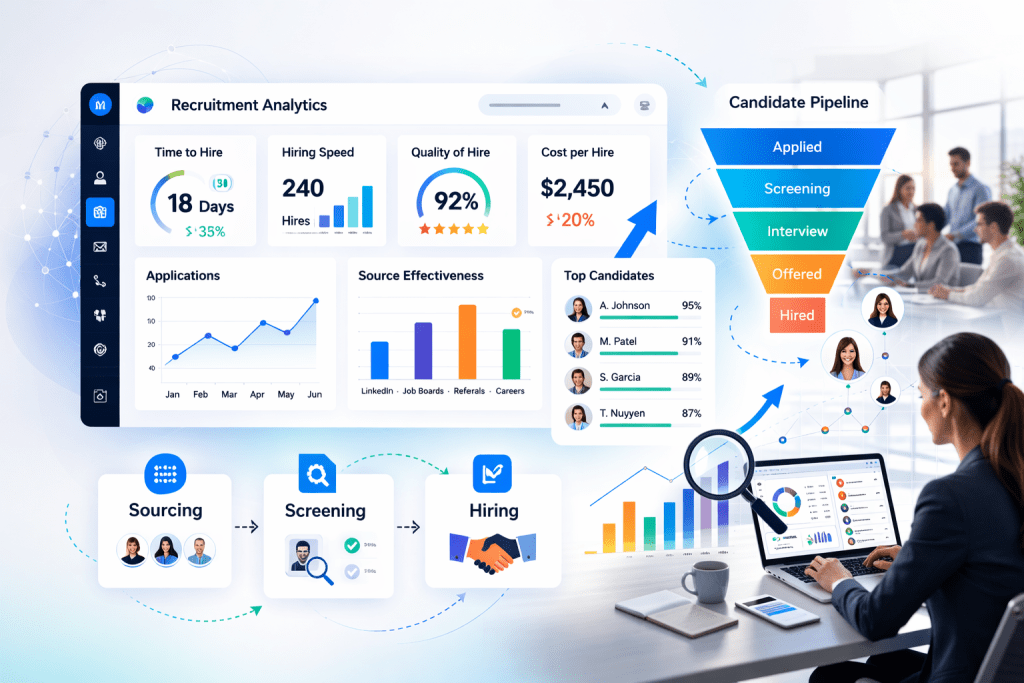
Include funnel and time-to-fill tracking. Recruitment data analytics should show you where candidates stall and drop out, along with the cycle time at each stage. That is how you find real bottlenecks.
Use simple, operator-friendly dashboards. Your teams should not need an analyst to interpret reports. Look for clear visuals, role and geography filters, and clear language narratives that describe what changed, where, and what to do. Ensure Compliance and Audit Support. The hiring analytics tool that you pick should also assist you in monitoring consistency and fairness in your hiring process. Decisions must be traceable.
Use Cases of Recruitment Analytics Software
Recruitment analytics software supports real work for your hiring leaders and front-line operators.
You can improve your sourcing strategy. See which job boards, referral programs, and internal sources produce hires who stay longer. Shift budget toward sources that drive higher retention rather than higher click counts.
You can tighten screening and selection. Talent analytics software highlights which assessment scores, experiences, or interview signals correlate with longer tenure. You can refine your screening rules and interview guides based on proof.
You can right-size staffing by location. Recruitment data analytics helps you forecast hiring needs by role and site, based on historical seasonality and turnover. That keeps store managers from scrambling to fill critical shifts at the last minute.
You can coach recruiters and hiring managers. Hiring analytics tools exposes where each team member excels and where they fall behind. Some might move candidates through the interview process quickly but struggle to close offers. Others move too slowly across the board. You guide training and workload using evidence.
You can monitor new programs. When you launch new pay ranges, scheduling policies, or sourcing channels, recruitment analytics software shows the impact on applicant flow, acceptance rates, and retention.
Benefits of Recruitment Analytics Software
An effective recruitment analytics tool provides profitable business benefits.
You get faster hiring without random shortcuts. Predictive scoring and clear funnel data enable recruiters and managers to focus their efforts on candidates with stronger signals. That shortens the time to fill while protecting quality.
You reduce early turnover. A recruitment analytics platform that connects pre-hire signals with post-hire outcomes helps you tune hiring profiles toward people who stay. Each avoided early exit protects the budget and stabilizes operations.
You improve the quality of hire. Hiring analytics software lets you link hiring decisions to performance reviews and key metrics. Patterns emerge about which profiles lead to better attendance, productivity, or customer scores.
You also achieve transparency across locations. Recruitment data analytics eliminates any arguments that some areas or brands are having difficulty recruiting. The numbers are the same for everyone.
You support compliance and consistency. Talent analytics software tracks decision patterns and highlights outliers. That provides legal and HR teams with evidence that processes remain aligned with policy.
You free teams from manual reporting. Automating hiring analytics tools reduces the time recruiters spend pulling spreadsheets. They focus on the candidates, not on the data wrangling.
Also Read: How Hiring Intelligence Software Predicts Candidate Success
Recruitment Analytics Software vs Traditional Hiring Methods
The conventional method of hiring employees relies on instinct, outdated reports, and personal recall. The hiring managers recall the last two unsuccessful hiring attempts. Recruiters react to the loudest complaints from the field. Leadership experiences high-level turnover and speculates on root causes.
Recruitment analytics software gives you a shared, verified view of what is working in hiring and what is not. Instead of debating opinions, your teams are aligned on actual performance and results. Identify which roles, shifts, and locations are experiencing the highest turnover, and adjust your hiring profile before turnover increases.
Traditional methods treat recruitment like a series of disconnected steps. A job is posted. Candidates apply. Someone interviews and decides. Data stays locked in each system or each manager’s notebook.
With a unified recruitment analytics platform, each step in the process feeds a continuous learning loop. Every decision improves the model for the next decision. You build a hiring engine that gets sharper with each requisition.
Who Should Use Recruitment Analytics Software?
Recruitment analytics software is for organizations that hire at scale and feel the cost of bad hires every day.
Retail, grocery, hospitality, logistics, healthcare, and high-volume eCommerce operations all benefit from a connected view of hiring and retention. If you manage many locations, seasonal swings, or constant frontline turnover, recruitment data analytics should be central to your strategy.
HR and TA leaders who own time-to-fill, turnover, and quality-of-hire targets need direct access to hiring analytics software, not filtered summaries. Operations leaders who feel the impact of staffing gaps need views tailored to their districts and roles.
Organizations with tight labor margins also gain from talent analytics software. Small shifts in early turnover or time-to-productivity compound across large hourly workforces. Analytics makes those shifts visible.
If your teams spend hours pulling hiring reports that still do not give clear direction, it is time to evaluate a recruitment analytics platform purpose-built for high-volume hiring.
Cadient centers its SmartSuite™ on intelligent high-volume hiring. Tools like SmartMatch™, SmartScore™, SmartTenure™, SmartSource™, SmartScreen™, and SmartTexting™ work together to predict retention, guide decisions, and keep hiring fast and accurate. If you want recruitment analytics software that ties every hiring choice to real outcomes, talk with Cadient about building a smarter hiring engine.