By Akshita Kohli · February 23, 2026
Your high-volume hiring process runs fast, but not always in the right direction. Roles fill, turnover stays flat, and frontline leaders lose trust in TA. Hiring intelligence software gives you signal instead of noise, so you can predict which candidates will stay and perform before you move them forward.
What Is Hiring Intelligence Software?
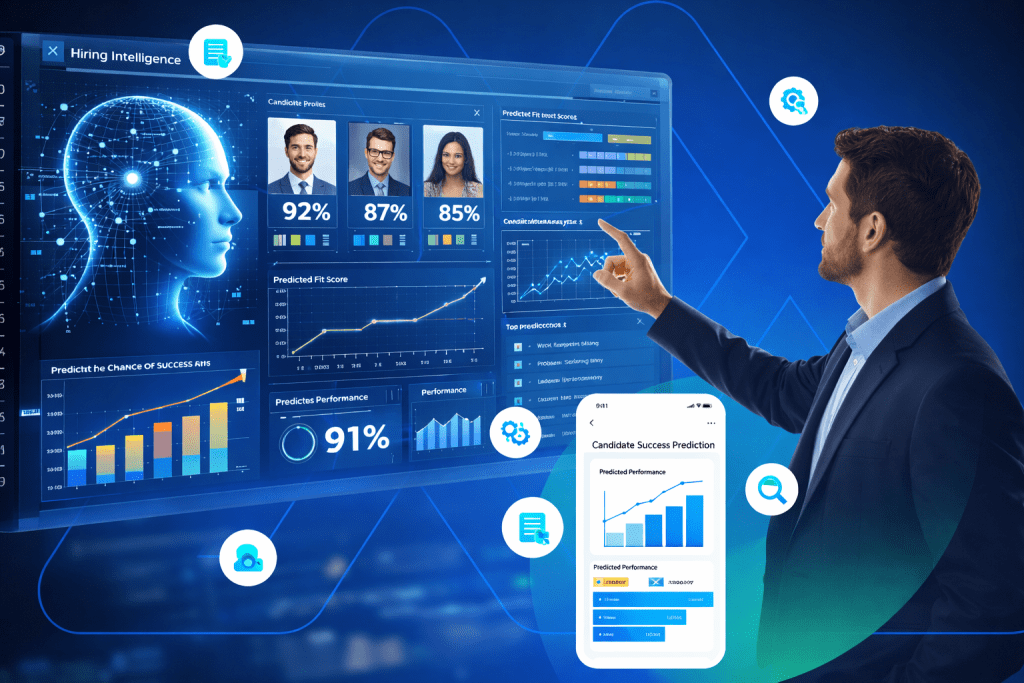
Hiring intelligence software is a set of tools that uses data, models, and workflows to guide each hiring choice. It pulls information from multiple sources, applies predictive analytics for hiring, and scores candidates based on the likelihood of fit and tenure.
Instead of relying on gut feel, hiring managers see clear evidence about each person. It can rank people by match to role, team, and performance patterns. You receive an always-on engine that enables data-driven hiring at scale.
When you look at the process from the perspective of an enterprise environment, hiring intelligence software “works” by integrating with your ATS system, your assessment tools, and your background check systems. This allows recruiters and/or operators to share a common understanding of risk, readiness, and retention for every person brought into the organization.
Also Read: Future of Hiring Intelligence Software in Enterprise Recruitment
Why Predicting Candidate Success Matters for Enterprises
Enterprise hiring teams operate under constant pressure. High requisition loads. Thin recruiter bandwidth. Tight store or site staffing targets. In this setting, candidate success prediction becomes a core operating requirement, not a nice-to-have feature.
When you accurately predict success, you reduce early quits, protect training investments, and stabilize schedules. Store managers spend less time refilling the same role. TA leaders can defend their strategy with data, not anecdotes.
Poor prediction shows up as churn, rework, and missed revenue. Every wrong hire forces your team to repeat sourcing, screening, and onboarding. Hiring intelligent software helps you break that pattern by aligning decisions with long-term performance, not first impressions.
How Hiring Intelligence Software Uses Data to Predict Success
Strong hiring intelligence software integrates historical and real-time data to predict candidate success. It looks at who you hired before, how long they stayed, and how they performed. Then it connects those outcomes to observable traits during the hiring process.
AI hiring software models use this data to score new applicants. They look for patterns inside your own workforce instead of generic benchmarks. This approach respects the difference between a distribution center, a call center, and a quick-service restaurant.
Cadient SmartMatch™, SmartScore™, and SmartTenure™ apply predictive hiring analytics to each applicant record. The system evaluates responses, experience, availability, and other signals. It then predicts both fit and likely tenure, so you see who is likely to succeed in your specific environment.
The result is a practical guide for recruiters. You still own the decision, but you no longer guess in the dark. Data backs each move in your workflow.
Key Metrics Used to Predict Candidate Success
To judge hiring intelligence software, you need to understand the metrics under the hood. The strongest platforms keep the focus on outcomes that matter to operators.
Core measures include:
- Time to first shift. How rapidly a candidate can transition from being hired to becoming actively engaged in work. The faster, the better.
- Tenure by cohort. How long do employees hired at different times stay? This is a factor in quality-of-hire analysis.
- Performance ratings or proxies. This could be attendance records, productivity measures, customer feedback, or internal performance-based labels.
- Quality of hire analytics. A combined view of tenure, performance, and rehire eligibility by source, recruiter, and hiring manager.
- Stage level conversion. Movement from apply to interview to offer to start, filtered by score bands from the hiring intelligence software.
When these metrics inform your models, your data-driven hiring decisions are aligned with real business outcomes rather than surface-level activity counts.
Benefits of Hiring Intelligence Software for Recruiters
Speed, not chaos, is what recruiters in high-volume settings need. Intelligent software in hiring to cut through the manual work and low-signal tasks supports that goal.
Key benefits include:
- Prioritized pipelines. Identify which applicants have the strongest predicted performance and tenure, then contact them first.
- Consistent screening. AI hiring software scores every applicant against the same standard, which reduces bias and random decisions.
- Less back and forth. Integrated tools, such as SmartTexting™ and SmartScreen™, minimize lag time.
- Defensible decisions. When your leaders second-guess hiring decisions, you can demonstrate the relationships among model signals, process decisions, and outcomes. These benefits will help your team create value through candidate experience, hiring manager collaboration, and workforce strategy.
Real-World Use Cases of Predictive Hiring
Predictive hiring analytics becomes most valuable when tied to specific, repeatable problems. A few examples show how this works in practice.
Retail and quick-service organizations use hiring intelligence software to rank applicants for store roles with known risk patterns. SmartScore™ highlights which candidates line up with the traits of stable, reliable workers in that store format. Managers see a short list to contact instead of a stack of resumes.
Contact centers use candidate success prediction to target hires who can handle schedules, call intensity, and customer expectations. By feeding attendance and handle time data into SmartTenure™, they generate models that favor employees who stay past key tenure milestones.
Distribution and warehouse operations rely on quality-of-hire analytics to link safety, output, and tenure to source and assessment results. This loop helps them invest in the right channels and update screening rules inside the AI hiring software.
Also Read: Benefits of a Data-Driven Hiring Platform for Modern Enterprises
Challenges in Predicting Candidate Success
Predicting human performance is never perfect. You need a clear view of the challenges before you deploy hiring intelligence software across your enterprise.
Data quality sits at the top of the list. If your performance ratings are noisy or your termination codes are unstructured, so are your models. You also need a minimum volume per role type to develop predictive hiring analytics.
Fairness and compliance demand attention. Any AI hiring software used for selection needs transparent logic, active monitoring, and regular audits. You must track impact across demographic groups and tune your models when you see drift.
Finally, there may be adoption challenges if user experience is neglected. Recruiters and hiring managers must have simple interfaces, clear scores, and trusted advice. If the system appears like a black box, the entire process will be ignored, and previous practices will be readopted.
How Enterprises Can Implement Hiring Intelligence Software
Success with hiring intelligence software starts with a focused plan, not a feature checklist. You begin by picking a few high-volume roles where turnover hurts most. Then you define outcome metrics that matter to operators, such as tenure targets and quality-of-hire analytics.
Next, you connect your ATS, assessments, and HRIS to give the platform a full view of the hire-to-tenure journey. This step enables data-driven hiring decisions rather than relying on partial guesses. With Cadient SmartSuite™, your team gets SmartSource™, SmartMatch™, SmartScore™, SmartTenure™, SmartScreen™, and SmartTexting™ working together from first touch to day one.
Training comes next. Recruiters learn how scores work. Hiring managers learn how to use ranked lists inside their daily workflow. You set clear rules for when to follow model guidance and how to document overrides.
Finally, you review outcomes on a regular schedule. You check candidate success prediction accuracy, early turnover, and hiring speed. You update models based on real performance. Over time, hiring intelligence software becomes part of how you run the business, not a side project.
Ready to replace guesswork with signal in your high-volume hiring process? See how Cadient’s hiring intelligence software supports predictive hiring analytics, stronger candidate success prediction, and data-driven hiring decisions across enterprise operations at Cadient.