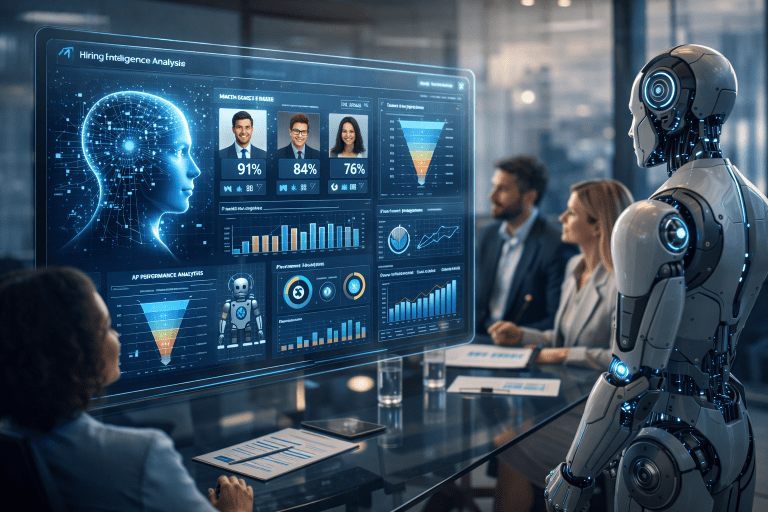
High-volume hiring puts you under pressure. You need speed and accuracy at the same time. Human screeners, manual review, and gut feel drag your teams down. AI candidate scoring gives you a different path. You move away from resumes in piles and focus on verified signal about fit and future performance.
In this guide, you see what AI candidate scoring is, where traditional evaluation breaks down, and how AI-driven candidate evaluation helps you make stronger, data-driven hiring decisions for every open role.
What Is Candidate Scoring
Candidate scoring is a structured method for rating each applicant against a clear set of hiring criteria. Instead of loose opinions, every candidate receives a score based on the same rules. You bring order to a process that often turns subjective.
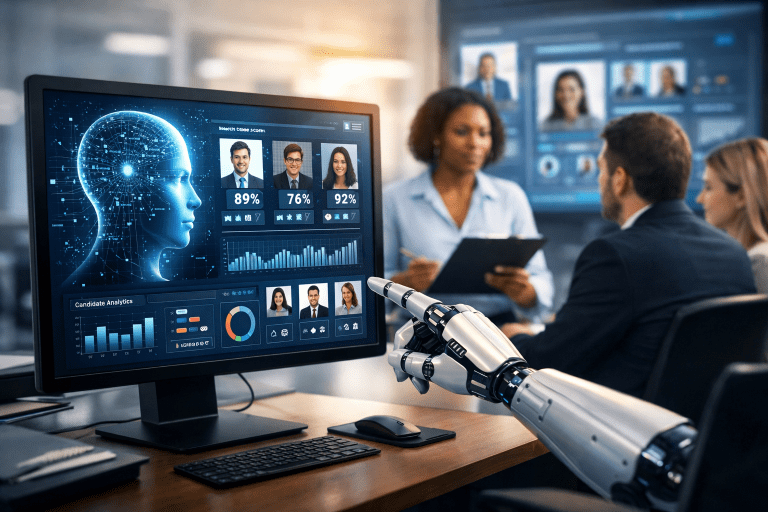
With AI candidate scoring, you use models to process information about applicants, past hires, and job requirements. The AI assigns scores that reflect predicted success and retention in a role. You move from one-dimensional checks to intelligent candidate scoring that weighs hundreds of data points consistently.
In high-volume environments, candidate scoring becomes your filter. Scores help recruiters see which applicants align with role requirements and company standards. Your teams spend time where it counts instead of scanning resumes for surface-level matches.
AI-driven candidate evaluation pushes this even further. It turns raw data into insight. It does not replace your judgment. It focuses your attention on the candidates most likely to succeed, based on evidence from your own hiring outcomes.
Challenges of Traditional Candidate Evaluation
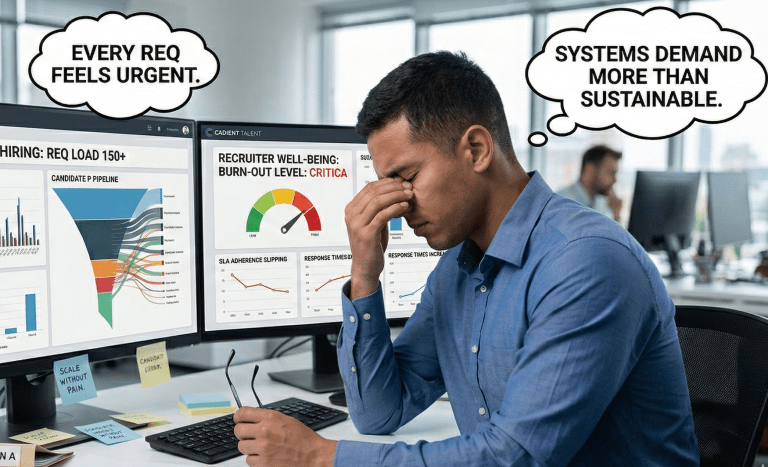
Traditional hiring processes rely on speed-reading resumes, quick phone screens, and rushed decisions by overworked recruiters or managers. That approach breaks fast when you deal with high-volume roles or distributed locations.
Subjective decisions and bias
Human reviewers use shortcuts. They skim job titles, schools, past employers, and location. Personal preference and bias slip in. Two reviewers review the same resume and come away with different views. Your hiring standard turns inconsistent across shifts, stores, and regions.
Subjective evaluation also hides the real drivers of success. You reward candidates who write polished resumes, not the ones who stay and perform on the job. Every time this happens, turnover climbs and your teams repeat the same hiring loop.
Incomplete view of candidate fit
Traditional evaluation focuses on basic requirements and often stops there. You check for required experience, availability, and location. You miss patterns such as schedule stability, prior tenure, or alignment with store traffic peaks.
That gap creates friction for operations. Store leaders feel the impact when new hires fail to show up or leave early. Recruiters move on to the next requisitions. No one has closed the loop on which signals led to those outcomes.
Slow response times
Manual review slows everything. Resumes wait in queues. Managers wait for candidates who already accepted other offers. Your strongest applicants move on, while your teams chase the wrong ones longer than needed.
You attempt to accelerate the process by shortcutting or lowering the bar. This compromise undermines the quality of hire and sustains a high turnover rate. You pay more to backfill the position.
Limited feedback loops
The traditional hiring process doesn’t link decisions to outcomes. You can’t establish a direct correlation between an individual’s performance in the process and their actual performance or tenure. Without this information, your hiring process never gets better.
This is where accurate AI-assisted candidate assessment changes the equation. AI recruitment scoring tools can use actual tenure and performance data to refine the signals they use, so your hiring decisions grow sharper over time instead of staying static.
How AI Improves Candidate Scoring Accuracy
AI candidate scoring applies machine learning to the data you already own. Applications, assessments, past hiring decisions, tenure data, and performance results all feed the model. The goal is simple. Rank candidates by their predicted success and retention in specific roles, based on evidence from your organization.
Standardizing evaluation criteria
With AI-driven candidate evaluation, every applicant is evaluated against the same criteria. The model does not tire or become distracted. It scores each candidate with the same structure. You remove variance across recruiters and stores.
You can also align the scoring model to business outcomes. For example, Cadient SmartScore™ helps you codify what success looks like in your own environment. You choose the outcome signals that matter for you, such as completion of training or on-time attendance, and the model learns from those patterns.
Integrating predictive retention signals
Strong hiring is not only about day one fit. You need people who stay. AI recruitment scoring tools ingest tenure data, role history, scheduling patterns, commute details, and more. The model identifies factors associated with stick rate for each role and location.
Cadient SmartTenure™ focuses directly on this problem. It scores candidates on predicted length of stay, based on your own historical hiring and retention data. You see a clear retention signal for each applicant rather than guessing from thin information.
Analyzing more data than human reviewers
Human reviewers review only a narrow slice of the available data. A resume and maybe a quick application form. AI reads more context. It processes application responses, assessment results, past employment patterns, interview data, and post-hire metrics.
This broader view supports accurate AI-based candidate assessment. You see the full profile rather than just one or two surface clues. The model also updates as new data enters the system, so your scoring stays aligned with current performance.
Reducing noise from resumes
Resumes vary in style and quality. Some candidates invest time in format and keywords. Others do not, especially in frontline or hourly roles. If you rely on resumes as your main filter, you let writing skills hide or exaggerate real ability and reliability.
AI-driven models help you reduce that noise. They downplay resume styling and focus on structured data that predicts outcomes. You can still review resumes for context, but your initial sort order reflects the objective signal.
Supporting faster, data-driven hiring decisions
When AI candidate scoring sits inside your hiring workflow, recruiters and managers see clear scores the moment a new application arrives. You can trigger SmartTexting™ outreach to high-scoring candidates and schedule interviews in hours, not days.
Data-driven hiring decisions do not slow down your teams. They give you a faster path to the right people. You spend less time debating which candidate to move forward with and more time engaging with high-potential candidates and those with strong retention signals.
Key Benefits of AI-Driven Candidate Scoring
AI candidate scoring is not a shiny tool sitting on the side. It touches daily work for recruiters and operators. When implemented correctly, it reshapes how you spend time and budget.
Higher quality of hire
Intelligent candidate scoring aligns your pipeline with the success criteria for each role. Candidates with a stronger match and higher predicted tenure rise to the top. Recruiters and managers spend more time with these applicants, so their final choices improve.
Because the scoring reflects your own historical outcomes, it adapts to differences across locations or business units. A high-scoring candidate for a distribution center might look different from a high-scoring candidate for a retail store. AI recruitment scoring tools adjust to those nuances.
Lower turnover and stronger retention
Turnover drains your team’s budget and energy. You know the visible costs, such as backfilling and overtime for coverage. You also feel the hidden costs in reduced customer experience and manager burnout.
AI-driven candidate evaluation with tools like SmartTenure™ attacks this problem directly. You prioritize candidates who fit the role and show signals linked to longer tenure. Over time, your front line stabilizes. Store leaders spend less time hiring and more time leading their teams.
Faster speed to hire without lowering the bar
Traditional efforts to move faster usually remove steps. That exposes you to more hiring risk. AI candidate scoring supports the opposite strategy. You gain speed from automation, not from cutting quality checks.
Scores are delivered instantly once a candidate completes the required steps. Recruiters can sort by score, launch SmartTexting™ sequences, or advance high-scoring candidates to the next stage. You hire faster and with greater confidence in each decision.
Consistent candidate experience
Candidates feel the downstream effect of your internal chaos. Delays, mixed messages, and unclear next steps hurt your reputation in the local talent market. A structured, intelligent candidate-scoring process brings order to the experience.
Each candidate gets a fair evaluation based on the same set of criteria. Candidates with high scores progress quickly in the system. Unselected candidates leave the system cleanly. You safeguard your brand while synchronizing your hiring capacity with the best talent on offer.
Clearer insight for TA and HR leaders
Data-driven hiring decisions also support better leadership choices. When you anchor hiring on AI candidate scoring, you see patterns that were invisible before. Which roles struggle with retention? Which locations deviate from predicted scores? Where hiring steps block quality candidates.
With Cadient SmartSuite™, you gain a connected view across sourcing, scoring, and screening. You can tie turnover cost, time to fill, and quality of hire back to each part of your process. That visibility helps you invest in the right levers instead of guessing.
Best Practices for Implementing AI Candidate Scoring
Choosing AI recruitment scoring tools is only part of the work. You need a clear plan for rollout, adoption, and ongoing improvement. The goal is simple. Put AI candidate scoring at the core of your process without losing human judgment or compliance standards.
Align on success metrics before you start
Before you configure any model, define what success looks like in your environment. For many high-volume teams, this includes tenure, attendance, training completion, and basic performance metrics. Bring operations leaders into this discussion so the model reflects the ground reality.
When you train AI models for candidate scoring based on these outcomes, you establish a clear connection between your hiring inputs and business outcomes. Everyone knows why a high score is important and how it relates to their business.
Use AI as decision support, not auto hire
AI candidate scoring systems are meant to support decisions, not make them. The final decision remains with the hiring team. The score helps them decide which candidates to evaluate and which questions to ask in the interview.
Frame AI-powered candidate scoring as a means of filtering out noise, rather than a black box. Add context to what the score means and does not mean. For instance, a SmartScore™ may be centered on predicted success and retention in a particular job family, rather than cultural fit or preferred roles.
Monitor model performance and refine regularly
Your hiring landscape is constantly changing. Seasonality, new store formats, policy updates, and compensation changes impact who applies and who stays. View AI-powered candidate scoring as a living entity that needs to be assessed and adjusted.
Work with your vendor to regularly assess scoring trends and results. Review hire rates and retention within score bands. Ensure that accurate candidate scoring using AI technology is still relevant within your current business environment.
Integrate scoring into recruiter workflows
AI candidate scoring only helps if recruiters use it. Place scores in the systems and screens your teams use every day. In Cadient SmartSuite™, scores from SmartMatch™, SmartScore™, and SmartTenure™ sit inside the same interface recruiters use for sourcing and communication.
Encourage simple behaviors. For example, review the highest-scoring candidates first each morning. Use SmartTexting™ to reach those in the top band instantly. Make the path from score to action short and clear.
Communicate clearly with candidates and managers
For managers, you should educate them on how the candidate scoring process works and its purpose: to provide a consistent means of evaluating candidates and to use data as the basis for hiring decisions. The process is not simply about automating hiring; it supports a standardized, data-driven approach to hiring candidates.
Candidates should also be made aware of the structured evaluation processes used to assess them through AI recruitment scoring solutions. Specifically, you should emphasize the speed and fairness of the evaluation process. Candidates want to receive a definitive answer within a short time frame; thus, AI recruitment scoring solutions will relieve the burden of providing a timely response from your team.

Conclusion
Traditional high-volume hiring leans on fast resume scans, inconsistent judgment, and rushed choices. That approach burns out your teams, increases turnover, and hides the real drivers of success in each role. AI candidate scoring gives you a path out of that pattern.
With AI-driven candidate evaluation, you bring structure and prediction into every hiring decision. You base your moves on evidence from your own outcomes. You give recruiters and managers a clear signal about whom to prioritize first. You protect speed while raising the bar on quality and retention.
Cadient builds intelligent candidate scoring into SmartSuite™ so you can move from guesswork to signal across every store, center, or region. SmartScore™ and SmartTenure™ help you rank candidates by predicted success and retention. SmartMatch™ and SmartSource™ improve the flow of talent into your pipeline. SmartScreen™ and SmartTexting™ keep the process tight and fast.
If you want AI candidate scoring that directly ties to time-to-fill, turnover cost, and quality of hire, schedule a working session with Cadient. See how predictive hiring and retention models fit your current stack, and where they replace friction with signal across high-volume hiring.
Ready to move from noise to signal in your hiring process? Talk with Cadient about AI candidate scoring today.
FAQs
What is AI candidate scoring?
AI candidate scoring is the process of using machine learning algorithms to evaluate each candidate’s potential for success and retention in a particular role. The score is based on patterns in your past hiring outcomes, not on industry templates.
How is AI-driven candidate evaluation different from traditional screening?
Traditional screening is often based on resume keywords and human intuition. AI-driven candidate evaluation is based on structured data about past hires, tenure, performance, and candidate responses. The AI evaluates each candidate on a consistent set of criteria, which helps improve the accuracy of candidate evaluation with AI.
Do AI recruitment scoring tools replace recruiters?
AI recruitment scoring tools help recruiters. They reduce the time spent manually screening candidates and help pick high-potential candidates. Recruiters and hiring managers still conduct interviews, make final candidate selections, and extend offers. AI systems recognize patterns and rankings, enabling human recruiters to engage in discussions and fit analysis.
How do you keep intelligent candidate scoring fair and compliant?
You must ensure fairness by developing good criteria for your models and periodically reviewing them. Collaborate with the provider of your model to identify what the predicted outcomes are based on your model, and then ensure that the data you will use to score candidates will be in compliance with the laws and policies. Periodically review your scoring practices by location and group. Be ready to continuously improve your models so that your AI candidate scoring system remains in line with your organization’s compliance goals and Diversity, Equity, and Inclusion initiatives.
What data do you need for accurate candidate assessment with AI?
Strong AI candidate scoring uses a mix of application data, screening responses, and post-hire outcomes. That can include tenure, attendance, training completion, and performance indicators. Providers like Cadient use this information to train models such as SmartScore™ and SmartTenure™ so your scores reflect real results inside your business, not generic assumptions.