By Ginni Gold · November 7, 2025
Introduction: The Real Cost of Losing Talent
The practice of hiring better usually gets most of the credit and attention, but the truth is that the real cost is hidden in losing the people that you have already trained.
It takes a lot of time and money to replace an experienced worker, so when he decides to leave, company growth slows down, the trust of customers diminishes, and newcomers become productive only after several months. According to Gallup, the cost of voluntary turnover to American companies reaches almost one trillion dollars every year.
The reasons for this cost, however, are not always about money or culture. Truth be told, most of the time it is all about timing. Most businesses realize that turnover has occurred when it is too late.
According to Gallup, voluntary turnover costs U.S. companies nearly one trillion dollars every year — a staggering figure that makes retention a bottom-line issue, not just an HR concern.
Employee retention software makes a difference in this situation. Such retention analytics, turnover prediction, and HR analytics to detect a possible departure of an employee, even before that is the case. The HR department is then able to intervene in advance, increase the employee’s commitment, and keep their top performers.
This manual explains how the use of predictive analytics helps to measure retention as opposed to merely guessing it.
1. The Turnover Challenge: From Reaction to Prediction
Once upon a time, employee turnover was an item on the agenda of post-action damage evaluation by the management. HR would go through exit interviews, try to figure out the reason, and start the recruitment process again.
That reaction-oriented manner of operating is not feasible anymore. Labor markets have become more dynamic, and employees are asking for more support and transparency.
Reasons why conventional methods fall short
- The data comes too late. Engagement surveys and exit interviews pinpoint issues only after employees have resigned.
- Information is scattered. Recruiting, onboarding, and performance records are most likely to be stored in different platforms.
- Decisions rely on opinion. Managers rely on their gut feeling rather than on facts.
Retention demands up-to-the-minute monitoring of the entire employee lifecycle — even before hiring and career progression.
A 2024 SHRM Workforce Study revealed that predictive models led to a 23% increase in retention during the first year. That is the huge difference of being able to anticipate turnover and taking measures to stop it.
2. What Employee Retention Software Does Differently
Conventional monitoring tools merely reveal those people who have left. The employee retention software brings out the employees who are thinking of leaving.
These devices gather information from platforms that handle recruiting, onboarding, engagement, and performance. After that, they use retention analytics and machine learning to locate the patterns that are connected to resignations.
What it does:
- Turnover prediction: Specifies the exact employees who are likely to leave, together with the time of doing so.
- Predictive hiring: Pinpoints the candidates who will most probably stay for a longer period of time.
- Onboarding software partnership: Monitors new hires’ progress and involvement.
- Retention dashboards: Provide HR with current staff well-being situation metrics.
- Mobilization: Prepares the user for the challenge ahead by revealing the risk factors and suggesting steps to be taken.
Such companies report on benefits like quicker response time, improved engagement, and better quality of hire as a result of employing predictive retention technologies.
3. How Retention Analytics Predict Turnover
Retention analytics enable the company to have a deep look at the input it gets from different sources, which reflects the staff’s common concerns and the solutions suitable for them (leave-if-based-on-whatever).
The science of turnover prediction
Turnover prediction models employ machine learning to examine a vast number of variables. Those variables are tenure of the employee, scores that measure his performance, his attendance, the manager getting replaced, and even the length of the commute.
The program will allocate to every worker a danger score. Once HR and managers observe these changes in performance or engagement, they receive notifications.
Typical risk points are:
- Decrease in logins or training completions.
- Absence of growth or promotions.
- There are salary gaps between people doing the same job.
- Very often changes in workload or working hours.
- Manager turnover or reorganization.
The goal of predictive models is not to replace human judgment but rather to provide managers with a heads-up that they should take action soon.
According to a 2024 Gartner HR Analytics Report, the use of predictive tools has been linked with a 37 percent turnover reduction that is preventable. This is only true when the manager’s outreach is also involved.
The use of retention analytics in a retail business example
A big retail brand in the US conducted employee retention software to find the reasons for the turnover of the hourly staff. Among the data, the distance to the workplace, the shift schedules, and the supervisor’s tenure emerged as the greatest three risk factors. Managers changed schedules and pairings as a result of which they were able to cut 90-day turnover by 21 percent in half a year.
4. Predictive Hiring: Retention Starts Before Day One
An employee’s retention is not after the first day. Actually, retention is the first moment when you choose a certain candidate out of all applicants.
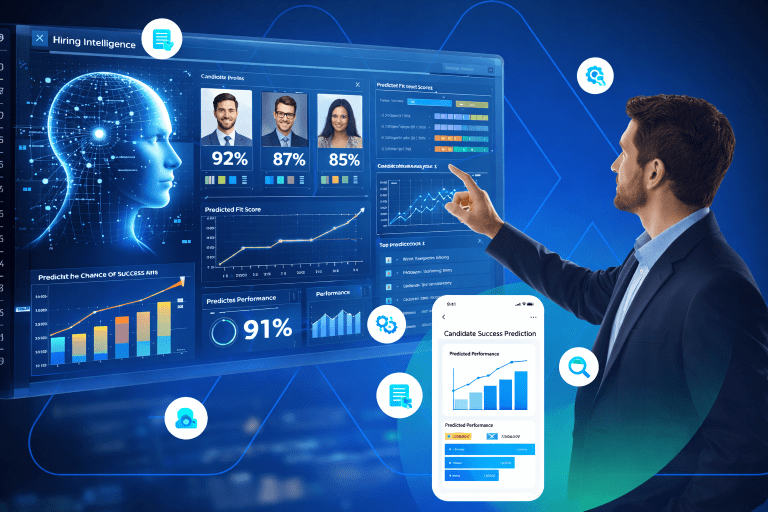
Predictive hiring analyzes the information of past employees to find out which characteristics are connected to the long-term success of a person. That way, the recruiter can ignore the rest of the candidates and focus only on the one(s) who will do well and remain for a long time.
How predictive hiring raises quality of hire
While traditional recruiting focuses on the candidates’ abilities, predictive models are more concerned with the results. They assess characteristics in the case of the example being given: not a lot of people are consistent, responsive, and their growth patterns lead to their longevity, but the qualities measured there are those for which those characteristics lead to longevity.
Examples of predictive hiring factors:
- The speed with which an applicant completes an application.
- The post is taking the interviewee’s style, engagement, and communication into account.
- The stability of one’s career in the previous roles.
- The results of the behavioral assessment.
If combined with a good employee retention software, predictive hiring becomes the link between the processes of hiring and retention. Every next recruitment provides information that deepens the accuracy of future forecasts.
LinkedIn Talent Solutions reports that predictive hiring analytics have led to a 29 percent increase in the quality of hire and a 35 percent rise in retention during the first year.
5. Onboarding Software: Where Retention Takes Root
Onboarding is the first impression that lasts. Poor onboarding is one of the strongest predictors of early turnover.
Onboarding software ensures new hires feel connected, supported, and informed from day one. When integrated with retention analytics, it tracks early engagement and flags issues quickly.
Why onboarding affects turnover prediction
- The employees who complete the onboarding tasks are 43% more likely to stay for one year.
- Employees new in the organization who meet their manager within the first week have 62 percent more chance of staying after six months (SHRM, 2024).
- The practice of regular check-ins during the first 90 days can reduce early turnover by 27 percent.
Simple as that: the main point is that engagement happens at the start of the process. Once employee retention software integrates onboarding and engagement data, firms are able to intervene before their workers’ issues escalate.
6. How HR Analytics Connect the Dots
HR analytics are the tools that combine all pieces of data to form a cohesive view. If linked with employee retention software, they reveal the holistic picture of the company’s workforce health.
What HR analytics track
- Reasons for voluntary terminations by manager, department, or location.
- Movement within the company and promotion rates.
- Quality of hire in relation to long-term performance.
- Employee engagement and survey sentiment.
- The price of labor turnover contrasted with that of retention programs.
According to the 2024 Deloitte Human Capital Report, corporations deploying integrated HR analytics increased retention by 31 percent and shortened the hiring cycle by 25 percent.
Predictive systems identify not only past events but also future possibilities.
7. Turning Data Into Action
Without follow-up, insight is nearly useless. Employee retention software equips managers with the means to intervene before situations escalate to resignations.
Effective use of retention analytics
- Empower managers with the insight. Equip them with the easy-to-understand risk indicator dashboards.
- Begin the installation of warning signs. If engagement or performance declines, then a notification should be your response.
- Behavior should be influenced by the usage of the results. Link the retention indicators with the leadership objectives.
- Watch the impact. Find out which actions result in better performance.
Predictive instruments yield optimal results when combined with dialogue. The data is the prompt; people are the ones who find the way.
Example: Healthcare retention through proactive intervention
One healthcare network utilized HR analytics and predictive dashboards to keep an eye on nursing teams. When the system recognized a risk of turnover, managers would schedule check-ins or coaching sessions. Unnecessary turnover dropped by 19 percent in a year. Engagement scores improved in all departments.
8. The ROI of Employee Retention Software
Retention achievements become exponentially powerful if given enough time. Every employee who remains will be a source of stability, mentorship, and continuity.
Outcomes that organizations can observe:
- 15–30 percent drop in voluntary turnover.
- 25 percent increase in quality of hire through predictive feedback.
- 20–40 percent reduction of hiring and onboarding costs.
When HR links retention metrics with business outcomes, the executive team sees talent strategy as a financial advantage.
The 2025 Gartner HR Insights study revealed that companies that implement predictive retention analytics outperform their peers by 24 percent in productivity and 19 percent in revenue growth.
Retention is not a cost to be controlled anymore. It is a profit lever.
9. What the Future of Retention Looks Like
The development of employee retention software is transitioning from prediction to personalization. The upcoming platforms will aggregate skills, sentiment, and career data to provide a single source of employee potential.
The future generation of systems will incorporate:
- Continuous employment sentiment measurement.
- Customized career path suggestions.
- Forecasted labor planning through HR analytics.
- Ongoing learning is connected to the quality of hire.
Retention will not be an HR function any longer. Instead, it will be a shared metric across the organization that reflects both performance and culture.
Key Takeaways
- Employee retention software is a move from reaction to prevention.
- Retention analytics and turnover prediction give managers the opportunity to intervene early.
- Predictive hiring and onboarding software pave the way for solid new hire relationships.
- HR analytics act as a bridge between engagement data and financial results.
- Predictive retention leads to higher quality of hire, lower costs, and increased trust.
Conclusion: Retention Is the New Recruiting Strategy
Smarter hiring is certainly a factor, but eventually, it is really about your best people, that is, keeping them. Predictive analytics provide the required insight for HR teams to be able to take the initiative and make their turnover rate go down.
Employers implementing employee retention software, utilizing retention analytics, and integrating HR analytics have moved beyond the stage of guessing—they can predict. Retention is achievable through different types of performance, such as taking preemptive measures, and it can also be linked to performance.Understand how Cadient SmartSuite™ can be instrumental in firms utilizing predictive analytics, getting onboarding insights, and having retention dashboards in order to speed up hiring, keep turnover rates low, and retain top talent for longer periods.