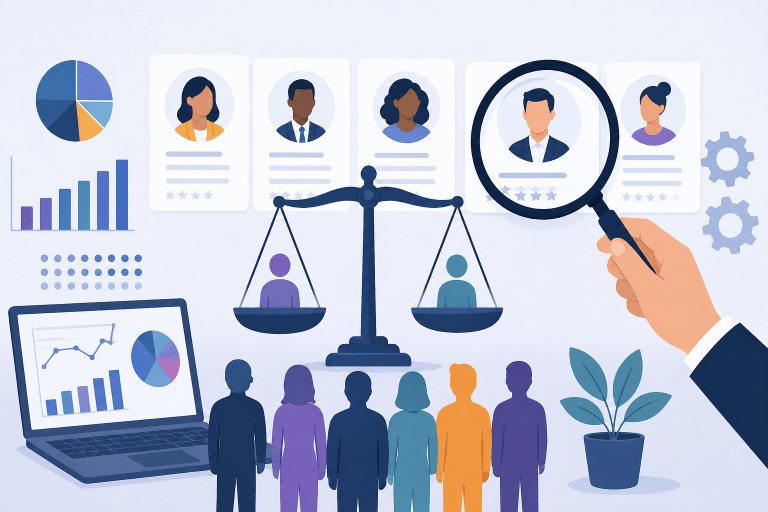
Organizations are always striving for more diversity and inclusion in their workforce. Now more than ever thanks to advanced hiring technologies, companies nationwide are on track to eliminating bias in recruitment. These tools streamline recruitment while providing data-driven insights to reveal where biases surface during the hiring process.
Manually reviewing applications and resumes can cause subjective biases whether hiring managers know or not. Switching to AI-driven solutions like resume parsing, natural language processing, and predictive analytics can guide the human resources team make more objective hiring decisions.
What Is Recruitment Bias?

Recruitment bias is any form of subjective thought that could contribute to hiring a candidate based on a favorable trait. Whether it’s gender, a shared hobby, race, or another background trait, these unconscious biases reduce candidate quality and skew hiring to become an unfair process.
Zippia reported that 48% of hiring managers admitted to one or more biases influencing their recent hiring decisions. A more staggering statistic reveals that 42% of talent acquisition professionals say an interviewer’s bias toward candidates is why an interview fails.
Unconscious Biases
One such example is an unconscious bias in hiring. This means automatic judgments are made based on a candidate’s characteristics observed during the interview process. A hiring manager could misconstrue someone’s traits to be something they are not or over-emphasize a particular favorable characteristic as their reason for onboarding them with the company.
Unconscious biases can hinder diversity and inclusion in the candidate pool. If these biases aren’t eliminated, companies will not experience the success of having a diverse talent pool based on quality skills and experience.
Biases Can Occur In All Stages of Recruitment
Such biases can happen in other parts of the recruitment process than just interviewing. If the job description wants to recruit only individuals with a specific degree, this leaves out other individuals with similar backgrounds.
For example, a job description for a Marketing Director should ask for a Bachelor’s in Marketing and Sales, a degree in a similar major, or combined years of experience. Hence, candidates have various options for their experience to qualify for the requisition.
How Predictive Analytics Reduce Recruitment Bias

Utilize predictive analytics for hiring to reduce the likelihood of recruitment bias. Evaluating historical data from current employee performance and past employees’ engagements can unveil the best characteristics of the ideal candidate for roles throughout your company. These data-driven insights can encourage a more tailored recruitment approach with defined skills and qualifications expected of the new hire.
Leveraging Data-Driven Insights
Such smart analytics centralize what skills and experience matter for each position to refine a quality candidate profile. This data-driven basis for candidate evaluation means that predictive analytics can eliminate subjective biases while unveiling any underrepresentation occurring while hiring. You can discover what attributes to high-performance metrics and job satisfaction to enhance employee engagement.
These metrics can enhance and adapt over time as recruitment trends change. As organizations continually gather data, you can refine your hiring strategy based on industry demands, required skill sets, and shifts in workplace culture.
Unveil the “Unheard-Of” Skills for Every Role
Technical and customer service skills are mostly emphasized in a cashier’s role. However, tapping into the “unheard-of” skills for each role in your company can enhance candidate quality. This tactic can also attract more candidates because of your unique workplace culture from the different values your company holds as high priority.
Let’s say for example that a grocery store is hosting a hiring campaign. They’ve evaluated historical data and found that current and past employees have exhibited a high emotional intelligence. What job description have you ever seen states that a cashier should have emotional intelligence?
That’s usually an unheard-of skill for a cashier’s role. However, it’s a warranted skill because it’s essential for conflict resolution. Not every grocery store customer will be peachy keen. More complex customer interactions will arise that involve evaluating their non-verbal cues and responding empathetically to solve conflict.
Implementing Bias Reduction Strategies
You need strategies to reduce bias to maintain a successful recruitment process. Let’s evaluate some actionable steps necessary to achieve these goals.
Standardize Job Descriptions
Job descriptions should be clear and in understandable language for everyone. Technical jargon that not everyone understands should not be incorporated into the description. This could deter candidates attempting to enter your industry from applying.
This tactic enhances diversity and inclusion in the talent pool for everyone to have a fair chance during the application process. Instead of saying that the candidate “must be a leader”, you can instead list the qualification as “can work collaboratively in a team setting”.
What if some candidates have only held entry-level roles and no lead-based positions yet? This kind of biased language can deter them from applying to the requisition. Using language that speaks to all candidates across different backgrounds can yield the best results for enhancing the candidate experience.
Structured Interviews
All the interview questions should be the same for each candidate. While you can have multiple-choice questions where a candidate must choose one of two to three options, it’s best to have more open-ended queries during the interview. This avenue ensures a fair and unbiased interview and evaluation process. Question standardization makes it easier for hiring managers to objectively compare responses to discover the highest-quality candidate for the role. The questions should encourage in-depth responses from each candidate where they have to tell stories related to their work experience.
Example of An In-Depth Interview Question and Great Response
One such question could be, “What are your tactics for multitasking effectively when you have multiple assignments during your shift?”.
Going with the same example of interviewing for a cashier’s job, a great response could be something like:
“When I was a Cashier at Save-a-Lot, I was scheduled with a Shift Leader and an Assistant Manager or Store Manager. It was all our responsibility to “pull the store” which means facing the goods on the shelves to make them look full. Hence, when there were no customers to check out, I fixed the candy at the checkout aisle and faced the shelves at the end caps nearest my register.”
“Sometimes I would have some candy or beverages to stock around the checkout area in between waiting on customers. This would also have to be done in my downtime. The best practice was to keep it moving and not stop until it was done.”
Diverse Hiring Panels
Assembling diverse hiring panels is a great way to reduce bias in recruitment. A mix of team members from recruitment, human resources, and upper management will have diverse experience, skills, and perspectives to objectively evaluate candidates.
The best hiring panels will challenge one another’s thoughts and opinions so there’s less chance of a groupthink dynamic. Therefore, it will achieve more objective decision-making. Candidates will feel more comfortable opening up about their experience during the interview when they see a diverse panel evaluating them.
Conclusion: Measuring Success
Various metrics should be regularly reviewed to ensure a streamlined recruitment process with eliminated bias. Assessing applicant pool diversity, employee retention metrics, and candidate selection rates are all valuable ways to reduce bias in recruitment. Continuously monitoring these metrics and adjusting strategies when necessary can help organizations foster a more inclusive workforce for future success.