By Abhishek Patel · March 24, 2026
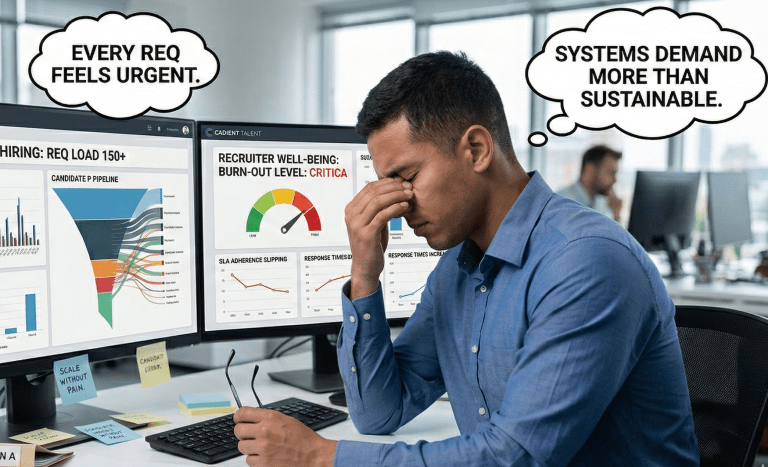
Your hiring system was designed for a slower market. High-volume hiring. Constant turnover demands. Fragmented data. Manual decision-making. You feel the pain with every request that takes too long to fill, every manager who’s lost faith in the hiring process.
Talent analytics for enterprises is your escape. Not another system that promises another view into the chaos, but one that reads your hiring metrics, predicts your hire’s success, and reveals the areas of your hiring process that cost you precious time, money, and talent.
In this guide, we’ll explore what talent analytics means, how the best teams use talent analytics for enterprises, and how you can take your organization from insights to decisions that matter for your business.
What is Talent Analytics?
Talent analytics is the application of data analytics within human resources to understand, predict, and improve decisions across the entire talent lifecycle. You use hiring, performance, and retention data to answer a specific question, and then use that answer to loop it back into your process.
Talent analytics, when it comes to high-volume hiring, is really about a handful of key questions for enterprises. Who should you focus on in the funnel? Which sources bring in the people who tend to stick? Where does your process get slow? Which managers override the data and cause unnecessary turnover?
Talent analytics, unlike traditional reporting, doesn’t stop at what happened. With a workforce analytics platform or a recruitment analytics software, you’re connecting people data across systems, creating patterns, and driving decision-making to outcomes within your business.
When talent analytics becomes a part of your operating system, it means that high-volume hiring moves out of the realm of intuition and into the realm of signal. When that happens, cost and turnover begin to move too.
Types of Talent Analytics
Talent analytics exists at several levels of depth. While you don’t need all of that at once, you need to understand what that means at the enterprise level.
Descriptive analytics
Descriptive analytics tells you what happened. You look at the number of applicants, the time spent in the hiring process, acceptance rates, and retention rates. Most ATS reports fall into this space. Good, but limited.
Diagnostic analytics
Diagnostic analytics tells you why something happened. You connect the dots between the steps in the hiring process. Why does that region have such high early termination rates? Do certain hiring managers take longer? Do certain job descriptions screen the wrong people for the job? Talent analytics starts to pay off at the enterprise level.
Predictive analytics
Predictive analytics is the use of patterns to predict the future. Predicting which applicants have the highest chance of succeeding in the position. Predicting the risk of early termination. This is where hiring analytics metrics actually becomes decision support, rather than just reporting. Cadient SmartMatch™, SmartScore™, and SmartTenure™ reside at this level, where high-volume applicants are scored for their likelihood of tenure.
Prescriptive analytics
Prescriptive analytics tells you what to do. Which applicants deserve immediate attention? Which channel deserves investment this week? Which geographies deserve investment based on hiring difficulty? A workforce analytics platform or talent analytics solution with decisioning capabilities helps force the user into this level.
Operational analytics
Operational analytics lives inside your business process. Scores appear in recruiters’ dashboards. Automated text messages alert high-fitting applicants. Hiring managers view ranked lists inside the ATS. This is where HR data analytics shifts from quarterly presentation to daily muscle.
Key Talent Analytics Metrics Enterprises Track
You don’t need a lot of metrics. You need a small, tight list of hiring analytics metrics that are connected to business outcomes. These are at the heart of talent analytics in businesses.
Time to apply and time to hire
Time to apply is a measure of how long it takes to apply. Time to hire is a measure of how long it takes, measured in days, from application to start date. When this time is long, it can mean that applicants are dropping out. In a high-volume hiring process, a short time to apply can mean a higher percentage of quality candidates apply quickly.
Stage conversion rates
You track conversions from view to click, click to apply, apply to screen, screen to interview, interview to offer, offer to hire. These are used in HR data analytics to identify leaks in the process. If the conversion rate from interview to offer is down in a particular region, you might investigate the process or expectations.
Quality of hire
Quality of hire is the connection between the hiring process and the performance and tenure of the hired individuals. Enterprise-wide talent analytics needs a simple performance signal, even if it is a manager rating at day ninety plus retention status. Predictive models need this as the target for SmartScore™ style scoring.
Early tenure retention
Early tenure retention is the focus of the first period of employment. For high-volume employers, this is the period that defines the turnover cost. Talent analytics tools, such as SmartTenure™, calculate the probability that the candidate will stay beyond this point based on historical patterns.
Source quality and source of hire
The source of hire tells you where your hired individuals came from. Source quality tells you where your best-hired individuals came from. Recruitment analytics tools connect source tags to performance and retention, not just volume. You stop paying for sources that produce early exits.
Hiring manager behavior
You monitor the average time spent reviewing, the percentage of offer declines, and the number of overrides. If the hiring manager is ignoring the suggested talent pool and hiring their own, you monitor the results. Eventually, HR data analytics reveals the hiring patterns that impact cost.
Diversity and representation
You monitor representation at each step. You look for trends where representation is falling off at certain steps, questions, or schedules. Enterprise talent analytics requires an understanding of fairness, which is important for both compliance and talent acquisition.
Benefits of Talent Analytics for Enterprises
Once you move beyond the basic reporting, the way your hiring operation works is completely transformed with talent analytics.
Faster hiring without blind risk
With predictive scoring, you contact the best candidates first. Interviews start sooner. Decisions happen sooner. Speed is increased, and quality is protected because you make decisions based on data, not assumptions.
Lower turnover and clearer retention risk
Talent analytics tools with a focus on retention provide insights into the types of candidates that tend to stay longer. You see the patterns based on the schedule, location, manager, and source of the candidates. SmartTenure™-style models predict turnover risk before the hire is made. Adjust your hiring criteria and scheduling to reduce turnover risk unnecessarily.
Better use of recruiting budget
Talent analytics for the enterprise helps you optimize ad spend based on the quality of the hire and the tenure of the hire. If a source is driving high volume but low quality and retention, you eliminate it or reduce it. If a source is driving high quality and high retention, you invest more in it. Budget follows the signal, not the habit.
Higher recruiter and manager productivity
With your workforce analytics platform embedded in your ATS, your recruiters are working off ranked queues, not flat lists. SmartScore™ brings forward the best-fit applicants. SmartTexting™ helps you engage with those applicants at the best time. Your managers receive fewer, more relevant candidates to review. Everyone gets more time for higher-priority activities.
Evidence-based workforce planning
HR data analytics helps you make accurate predictions about your future needs. You want to predict how many applicants you’ll need in the coming quarter, by job type and location, based on past conversion and retention rates. You want to plan for seasonal demand, store openings, call center volume, or production shifts.
Stronger internal credibility
When you walk into a leadership meeting with hiring analytics metrics, you stop debating feelings. Talent analytics for enterprises gives you proof of where hiring is working and where it is hurting your business. This is what gains investment.
Talent Analytics Tools and Platforms
You need recruitment analytics software and talent analytics tools, and those tools need to integrate with your actual workflows.
Core data and reporting layer
You store most of your data in your ATS, HRIS, and scheduling tools. For larger organizations, you may also want to store your data in a data warehouse or a workforce analytics platform, which sits on top of your other tools and normalizes all of your data into one place.
Predictive scoring and matching tools
This is where Cadient’s SmartSuite™ comes in. Our tools, such as SmartSource™, optimize your job distribution based on performance and retention, not just clicks. Our tools, such as SmartScore™ and SmartMatch™, look at candidate data and compare it to successful employee patterns, providing recruiters with a list of candidates for each job opening.
Retention and tenure prediction
SmartTenure™ actually predicts how likely each candidate is to stay past your critical tenure period, and this sits directly in front of your recruiter and hiring manager.
You want your talent analytics, your enterprise talent analytics, to actually be a live input into every single hiring decision you make.
Screening and compliance tools
SmartScreen™ unifies background screening and compliance in one workflow and data model. See the effect of screening rules on time to hire and dropout. Adjust your screening rules with complete awareness of the downstream effects.
Engagement and communication tools
SmartTexting™ streamlines candidate communications using status, score, and stage criteria. Fast-track communications for the best-fit candidates. Track responses and determine which communications correlate with higher acceptance and show rates.
Self-service analytics and dashboards
Recruiters need simple views of the pipeline. Leaders need views of multiple locations and/or multiple roles. Good talent analytics solutions meet both needs. Establish your standard set of hiring analytics metrics. Then, provide secure access to the data by role. Work from one source of truth.
How to Implement Talent Analytics in Enterprise Hiring
Implementation doesn’t begin with tools; it begins with well-defined hiring problems and a plan to measure those problems.
Define the outcomes you care about
Choose a few results that are linked to money and risk. For high-volume hiring, time to fill, early tenure retention, and first-year performance often make the top of the list. Every HR data analytics project should connect back to these results.
Audit current data and processes
Identify the places where hiring data is kept. This includes the applicant tracking system, HR information systems, third-party job sites, background checks, tests, texting tools, and store-level trackers. Identify the gaps in the data. For instance, performance ratings that don’t ever make their way back into recruitment analytics tools.
Standardize and clean key fields
You need stable IDs and standardized fields for things like the role, location, source, and manager. You need clear stage definitions within the hiring process. Enterprise-wide talent analytics fails when the data means one thing in one region and another in the next region over.
Select the right workforce analytics platform
You want platforms that fit your hiring model, not generic BI solutions. At high volume, you want built-in features such as SmartScore™, SmartMatch™, SmartTenure™, SmartTexting™, and SmartSource™, all of which should be natively available to your recruiter workflows. The appropriate talent analytics solutions should prevent the need for spreadsheet solutions.
Start with one or two priority use cases
Start with focused problems, such as reducing early attrition in a particular front-line role or reducing time to hire for a seasonal ramp event. Configure your recruitment analytics platform to score, measure, and optimize your candidate workflows, and then expand.
Embed analytics into daily decisions
Scores need to live where the work gets done. In requisition views. In mobile manager approvals. In candidate queues. Educate recruiters and managers on how to use hiring analytics metrics, not how to look at dashboards.
Close the loop with performance and retention data
Talent analytics for enterprises is never a one-time thing. You learn from new hire performance and tenure data. And over time, your scoring gets better. You optimize your job ads, your screening questions, your interview guides.
Challenges in Talent Analytics Implementation
Enterprise scale is full of challenges. You can overcome them if you think about them.
Fragmented systems and ownership
Some of the data is owned by HR. Some of the data is owned by operations. Some of the data is owned by IT. And sometimes the vendors are right in the middle. You have to have good governance. For instance, who owns the results of talent analytics, and who owns the standardization of the process across locations and brands?
Poor data quality
Incomplete applications, inconsistent job titles, the lack of source tags, and notes written manually all impede HR data analytics. The solution is better workflows, better form fields, and automation, not typing more for recruiters. SmartSuite™ helps ensure structure within the hiring flow.
Change resistance from recruiters and managers
Some recruiters trust their gut more than the score. Some managers think that the data is slowing them down. The solution is to connect the recruiters and managers with the value of talent analytics tools. For instance, easier shortlists, fewer no-shows, better retention, so they don’t have to hire the same position every month.
Privacy and compliance concerns
Talent analytics for enterprises must also address the issue of privacy. Therefore, you have to have clear guidelines on the use, retention, and accessibility of the data. Moreover, you have to involve the legal department early on. Lastly, the models have to use job-related signals, ensuring that they also address the issue of fairness.
Overcomplicated analytics projects
Large internal analytics projects have the tendency to fail. Too many cooks, too much custom work, and too little connection to actual requisitions. Start with practical cases that have been proven with existing recruitment analytics software that understands high-volume hiring.
Failure to measure impact
If you cannot measure the impact of talent analytics for enterprises, showing that the solution helps lower turnover cost, speed up time to fill, or improve the quality of hire, the support for the solution will disappear. Therefore, establish metrics early on, even before rolling out the solution.
Future of Talent Analytics
Talent analytics is moving from separate analytics teams to embedded hiring infrastructure, and for high volume employers, this means three major trends.
Deeper predictive models tied to tenure
Predictive models will increasingly incorporate retention results, not just first day fit. For example, with SmartTenure™, tenure predictions are used to make every front-line hire decision, and ultimately influence scheduling, shift design, and even location.
Unified workforce analytics platforms
The future will see point solutions replaced by platforms that incorporate ATS, HR Data Analytics, Recruitment Analytics Software, communication, and screening, and with SmartSuite™, we’re seeing a glimpse of what this future holds, where hiring decisions all stem from a single data spine.
Real time decision support for managers
Managers will see recommended candidates, pay, and schedules within one interface. Talent analytics will also make adaptive recommendations based on manager behavior and results. High friction steps will decline significantly. Manual approvals will become less relevant.
Greater focus on ethical and transparent models
As the reach of predictive hiring grows, the stakes for fairness and transparency will rise for enterprises. You will need to explain your scoring model in simple terms and measure the effects across populations. Companies that make ethics a core aspect will gain trust.
Closer link between hiring and business performance
Talent analytics for enterprises will integrate hiring decisions with store performance, customer experience, safety, and retention within a single view. HR will join the ranks of operations and finance as a data equal, rather than a soft discipline.
If you’re ready to move your hiring operation from guesswork to signal, see how Cadient aligns Predictive Talent Analytics with High Volume Hiring to hire faster, retain longer, and stop paying for broken processes.