
When you are hiring large numbers of employees on an hourly basis, you understand the pain involved. Store managers are short-staffed. The call centers are backed up. The distribution centers have vacancies in their shifts. You have empty seats that need to be filled immediately to retain employees. The traditional method holds you back in hiring. It is nothing but noise in your process. The best candidates are masked. Artificial intelligence in hiring solves your problem. But it has to be done properly.
What Is High-Volume Hiring
High-volume hiring is the process of filling many jobs in a short period, often for similar roles. These are jobs that involve retail workers, warehouse staff, and call center reps. These jobs do not involve hiring ten software engineers in a quarter. High-volume hiring involves hiring thousands of retail workers in a very short period.
The price of inaction is high. The annual turnover rate in some industries is close to or exceeds 100%. In retail in the U.S., employee turnover exceeds 60 percent annually. This means that within two years, a considerable majority of employees in your business will leave. Losing them has several implications beyond filling a job opening.
High-volume recruitment with AI is centered on this scenario. It relies on data, pattern recognition, and automation of recruitment processes to act quickly while maintaining signals on qualifications, quality, and potential retention. More resume submissions are not what recruiters want. Recruiters want more applicants who start, show up, and stay.
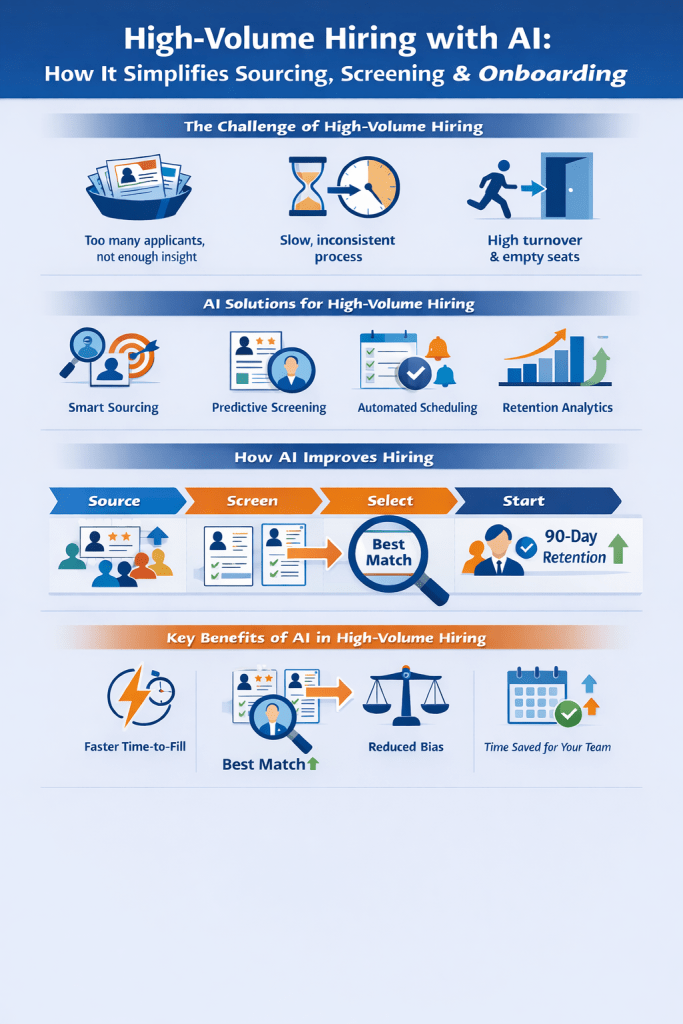
Challenges of High-Volume Hiring
Legacy hiring approaches were built for corporate jobs, not 500 open requisitions across 200 locations. When you push those tools into high-volume hiring, the weak points show up fast.
Core challenges include the following:
• Too much supply of applicants, too little signal from screening
• Slow response times that lose candidates to faster competitors
• The decisions taken by the managers are not uniform throughout all locations.
• Poor visibility into which hires stay and which leave fast
• Manual steps that burn recruiter and manager time
Speed itself isn’t the answer to this. Make the wrong decisions, and you only accelerate turnover. The average cost of a bad hire for hourly roles can reach 30 percent of annual earnings once you factor in recruiting, training, and lost productivity. Multiply that by hundreds of attrition events, and you see how much value drains out.
Manual screening and gut feel also fall at scale. Recruiters spend close to 60 percent of their time on repetitive tasks, such as screening and scheduling, rather than on higher-value work. High-volume recruitment automation aims to reclaim that time and route it to where human judgment is best placed.
Also Read: How AI Is Transforming the Recruitment Process
Role of AI in Streamlining High-Volume Hiring
AI in recruitment should not replace your team; it should remove friction at every stage of the funnel so people can focus on decisions, not data entry. For high-volume hiring using AI, the right system acts like a decision engine in real time, sitting inside your workflow.
AI volume hiring solutions
• Candidate rating, done objectively against job-specific models
• Predict the likelihood of success and tenure for each hire.
• Automate outreach and reminders, appointment scheduling
• Surface the best next action for each applicant
When you connect AI to real outcomes like start rate, 30/60/90 day retention, and performance, you transcend buzzwords. You turn your data into a learning system that avoids repeating the same mistakes.
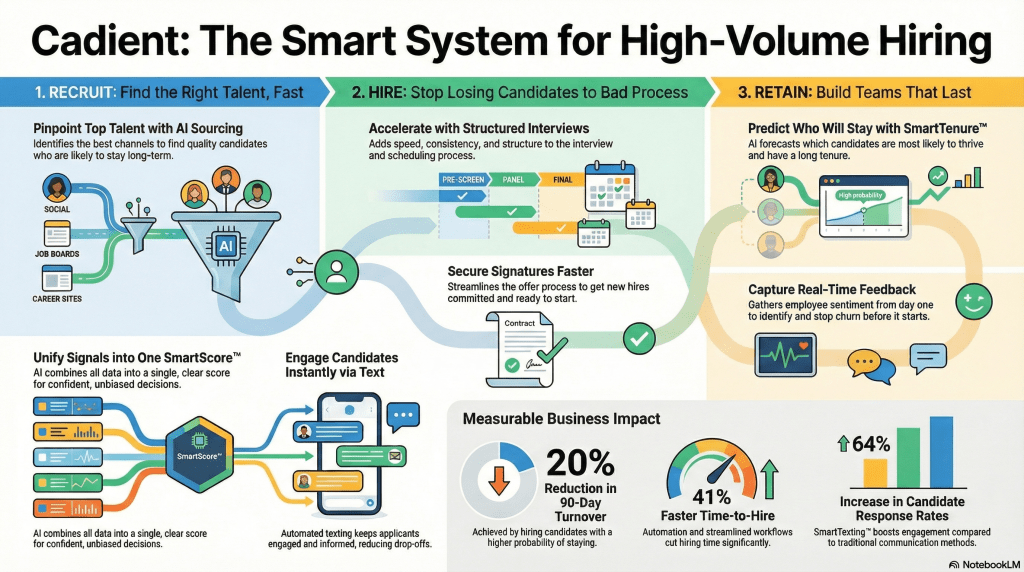
Cadient SmartSuite™ is based on this very principle. A suite consisting of SmartMatch™, SmartScore™, SmartTenure™, SmartSource™, SmartScreen™, and SmartTexting™ operates in harmony to automate high-volume workflows while safeguarding fit and long-term value.
How AI Simplifies Candidate Sourcing, Screening, and Onboarding
The traditional way of sourcing frequently becomes a numbers game. More job boards. More jobs are advertised. More candidates. This leads to a chock-full funnel, and your top talent has to wait too long to hear back.
With AI-based recruitment tools, you can:
• Find which sources give the best click-through results but also the best rate of retention.
• Spend shift to long-term sources of hire
• Auto-prioritize candidates from the best quality channels for quick review
The Cadient SmartSource™ analyzes the company’s hiring history and directs the sourcing process toward sources that yield better hires. The company eventually stops paying sources that are busy or do not produce employees who last.
Screening: Replace gut feel with predictive signal
Screening is where high-volume teams usually waste most of their time: Recruiters and managers scroll through resumes, scan incomplete applications, and take wild guesses as to who might work out. This creates biases and inconsistency.
AI hiring solutions cut through this by:
Assessing candidates against role-specific models
• Weighing skills against experience, availability of candidates, and behavioral indications
• Flag high-potential candidates within minutes of application
• Standardization of scoring across sites
Solutions such as SmartMatch™ and SmartScore™ provide a data-driven score for each candidate, so your team can start with the right people first. SmartTenure™ adds a layer on top of this signal, revealing predicted stay potential to help you avoid rapid churn that can decimate your budget.
Quality of hire is a tangible business metric, not an abstract concept. LinkedIn research found that 39 percent of talent leaders ranked quality of hire as the most valuable performance metric. Predictive scoring tied to outcomes builds that quality into every decision, rather than leaving it to chance.
Onboarding: Connect acceptance to day one and beyond
The difference in high-volume hiring is this: accepted offers do not fill shifts. You have to have candidates to fill out the paperwork, qualify, and attend on day one. Anything lacking in this process results in a “drop-off.”
Recruitment process automation using AI helps in the hiring process in the following ways
• Automatic execution of background checks each time a candidate is selected
• Sending reminders for documents & forms
• Manage the schedule and start dates through intelligent messaging systems
• Notifying managers of the possibility of an incoming employee falling behind
SmartScreen™ and SmartTexting™ help eliminate the aforementioned gap. The background process will run in the background, and the candidate will be able to see the text message, which will enable them to move forward.
Also Read: Reducing Time-to-Hire With AI-Powered Screening
Key Benefits of Using AI for High-Volume Hiring
1. Faster time to fill without sacrificing fit
By automating screening and prioritization, your team will respond to top candidates in hours rather than days. Studies have shown that companies that automate their hiring processes most effectively can fill positions up to 20 percent faster. In a high-volume store environment, getting the hiring process one or two days sooner is critical to store coverage levels.
Since you are using predictive tools such as SmartMatch™ and SmartScore™ that are driven by fit as well as speed, you are not compromising on quality in the interests of speed. You are aiming at people who are not only available but are also a good fit for the job.
2. Lower turnover and stronger retention
Each type of early exit has a hard-dollar cost. Work Institute puts the cost of replacing a frontline employee at 30 percent of annual salary. In high-volume recruiting, small improvements in employee retention easily translate into big financial gains.
High-volume recruiting with AI relies on past data to identify patterns of who stays. SmartTenure™ takes those patterns and applies them to new candidates, pointing you towards those who are more likely to stay. Ultimately, the decision remains with you, but now you make it from an educated perspective on the “stay” risk rather than guessing.
3. Less bias and more consistent decisions
Manual screening invites inconsistency. Two managers look at the same resume and reach different conclusions. That variation is risky and unfair. With AI in recruitment, you apply the same criteria to every applicant, then use that signal to guide structured conversations.
It’s all about transparency and monitoring. You should know what data points drive scores, and continuously test the model for fairness. Done right, AI management supports a fairer selection and enhances the candidate experience. According to IBM research, organizations that focus on candidate experience offer acceptance rates up to 30 percent.
4. Recruiter and manager time back
High-volume groups will likely be working with a lean headcount. Each repetitive process you automate will put more time back into the hands of the front line. In the study, the time saved per week from manual processes ranged up to 14 hours, as reported by recruiters who used automation. This is the time you can put into training, building relationships, and workforce planning.
SmartSuite™ packages this power by integrating SmartSource™, SmartMatch™, SmartScore™, SmartTenure™, SmartScreen™, and SmartTexting™ into a single process. Rather than working from different sources of truth, this allows your team to access everything from a single source.
Best Practices for Implementing AI in Recruitment
Start with clear outcomes
Before you add any AI hiring solutions, define the business problems you need to solve. Common targets in high-volume hiring include:
• Time-to-fill reduction by a certain number of days
• Improving 90-day retention for key roles
• Reduce agency spend for frontline positions
• Increase hiring manager satisfaction scores
Measure current baselines first. Then configure AI models and workflows around these targets so you can track impact and adjust fast.
Connect data from the application to tenure
High-volume recruitment automation is only as good as its data. Connect ATS data, assessment results, scheduling, and HRIS outcomes, so you see a full picture from application date to tenure milestones. Cadient SmartSuite™ ties these signals together in support of predictive hiring and retention.
Once your data is connected, you can:
• Identify which profiles drive higher performance and tenure
• Refine scoring models as roles or labor markets change
• Report on ROI using metrics that matter to finance and operations
Keep humans in the decision loop
AI-powered talent acquisition should support people, not overrule them. Use AI to:
• Prioritize who to review and interview
• Expose risk factors and fit signals
• Standardize structured interview questions
Recruiters and managers still own the final choice. Pair predictive scores with human judgment built on real context from each site or region.
Communicate with candidates clearly
The process in high-volume hiring is fast. Candidates need regular communication. For you to apply artificial intelligence in recruitment, you need to define the communication process with your potential employees. You should clarify how they will be involved, how the process is carried out, and what will follow.
SmartTexting™ helps achieve this by communicating thoughtful, targeted texts that keep candidates informed without increasing task work for your team. Accurate communication boosts completion rates for applications, tests, and steps towards onboarding, and also improves perceptions of your employer brand.
Monitor, audit, and improve models
AI is no set-and-forget solution. Establish a routine review loop involving the HR, TA, legal, and operations teams. Review:
• Distribution of scores according to location, role, and demographics
• Conversion and retention rates per score range
• Patterns triggering concerns about fairness or compliance
Collaboration with your provider to refine models and guardrails, depending on results, will be important. SmartMatch™, SmartScore™, and SmartTenure™ are built with this level of optimization in mind to refine your hiring process each year.
Conclusion
Volume recruiting using AI is not about trends. It is about repairing a defective process by asking recruiters and hiring managers to manage the sheer volume of applicants using tools from the last era. You bring together the best of AI recruiting with clear outcomes, related data, and human insight, and then you achieve speed, accuracy, and retention simultaneously.
Cadient delivers intelligent high-volume hiring to help support businesses in quickly filling frontline positions without sacrificing control over quality. SmartSuite™ applies the use of predictive models and real-world hiring expertise to help filter signals from noise and enable you to assemble a team that stays. If you are ready to stop guessing and start operating with data, see how Cadient can reset your high-volume hiring system.
FAQs
What is high-volume hiring?
High Volume Hiring refers to the process of hiring people to fill many similar positions within a set period of time, often for frontline hourly positions. This process follows repeatable business processes, has the same set of requirements across different regions, and requires robust automation to remove bottlenecks.
In high-volume recruiting, how does AI assist?
It also helps screen candidates, predict their chances of success and retention, and automate other activities such as screening, scheduling, and texting. In a high-volume setting, it increases the efficiency of screening and filling positions while ensuring a better fit between candidates and jobs.
What is the key difference between AI recruitment and traditional automation?
Classic automation is more concerned with rule-based activities, for instance, sending emails and advancing candidates through different stages. AI recruitment combines predictions and learning from past events. In addition to advancing candidates faster, it identifies which candidates to advance ahead of others through retention.
Does the application of AI in recruitment increase or decrease biases?
Bias can be alleviated if the design and implementation are right. Consistent criteria are applied equally to all applicants. Biases are revealed as a pattern ripe for audit. Yet the need for safeguards remains to prevent the replication of past biases in future applications.
Which Cadient products are used for high-volume hiring using artificial intelligence?
The Cadient SmartSuite™ provides intelligent high-volume hiring capabilities through integrated products. The SmartSource™ product enhances sourcing, and then there’s SmartMatch™ and SmartScore™ for predictive screening, SmartTenure™ for retention risk analysis, a background screener called SmartScreen, and automated communications for high-value candidates using SmartTexting™.