Your hiring process runs on gut feel, spreadsheets, and pressure from the field. Stores need people fast. Operations wants coverage. Finance pushes labor targets. You sit in the middle and address turnover, time-to-fill, and candidate drop-off.
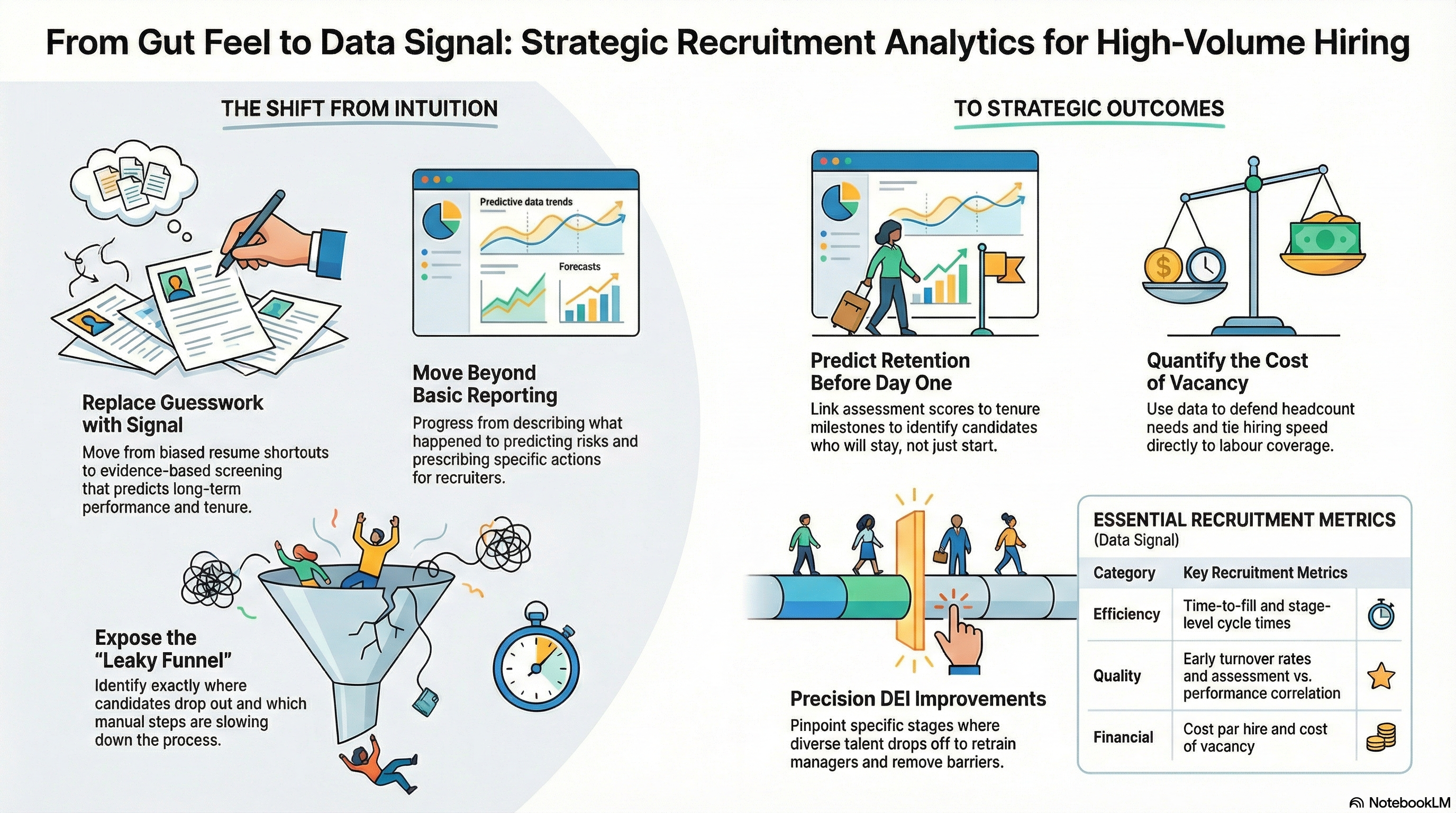
Recruitment analytics gives you a way out of constant reaction mode. It shows where your hiring system leaks, which roles drive turnover cost, and which decision points slow everything down. It replaces guesswork with signal, so you can defend decisions with data and protect both speed and fit.
If you own high-volume talent acquisition, you do not need more dashboards. You need recruitment analytics tied to outcomes that matter: who you hire, how long they stay, and what it costs you when they leave.
What Is Recruitment Analytics
Recruitment analytics is the use of hiring data insights to measure, predict, and improve hiring results. It pulls information from every step of your funnel. You track applicants, interviews, offers, hires, and tenure. You combine this with recruiter actions and hiring manager decisions.
Recruitment data analytics connects all of this into a clear view of performance. It shows which sources produce hires who stay. It highlights which assessment scores are tied to retention. It exposes which locations reject strong candidates or move too slowly.
When you treat hiring as an operational system, recruitment analytics becomes your control panel. You stop guessing where the friction sits. You see it.
Why Analytics Is Essential in Modern Talent Acquisition
High-volume hiring moves fast. Decision cycles are short. Without talent acquisition analytics, you feel every spike in demand but see little about the root cause.
Analytics in talent acquisition lets you:
- Quantify the cost of turnover for specific roles and locations
- Defend headcount needs with hard data, not opinion
- Expose manual steps that slow down the time to hire
- Hold vendors accountable using recruitment metrics and KPIs
HR analytics recruitment also strengthens your position with leadership. You stop reporting activity only. You report risk, savings, and measurable trade-offs.
Also Read: Scaling Hiring Operations Without Increasing Costs
How Recruitment Analytics Transforms Hiring Decisions
Most hiring decisions still run through habit, bias, and local preferences. A manager prefers certain schools. Another dislikes candidates who change jobs often. None of these tracks to performance or tenure.
Recruitment analytics changes the decision input. You align hiring decisions with evidence from hiring analytics rather than opinion. Examples include:
- Screening based on predictors of retention and performance, not on resume shortcuts
- Adjusting interview steps based on conversion data
- Routing top candidates to responsive hiring managers first
- Prioritizing requisitions with the highest cost of vacancy
With data-driven hiring, you reduce random variation across locations. You teach managers what good looks like in their context, based on outcomes from their own teams.
Key Types of Recruitment Analytics: Descriptive, Predictive, Prescriptive
Recruitment analytics comes in three main forms. Each plays a different role in your strategy.
Descriptive recruitment analytics
Descriptive analytics answers the question, what is happening. You track recruitment metrics and KPIs across your funnel. Examples include:
- Applicants per role and per source
- Time in each hiring stage
- Offer acceptance rates
- Early turnover by role and location
This view tells you where to focus, but not what to do next.
Predictive recruitment analytics
Predictive recruitment analytics answers the question of what is likely to happen. It analyzes patterns in your historical hiring data and flags future outcomes. Examples include:
- Likelihood a candidate will accept an offer
- Risk of early turnover for a specific hire
- Expected time to fill for a role based on season and location
- Projected applicant flow from each source
This level alerts you to risk before it hits your stores or sites.
Prescriptive recruitment analytics
Prescriptive analytics answers, what should you do. It turns prediction into recommended actions. For example:
- Auto prioritizing candidates with high retention scores
- Suggesting alternate sources when applicant volume drops
- Recommending pay or schedule ranges to improve acceptance
- Triggering outreach when a high-value candidate stalls
This is where recruitment performance analytics becomes operational. The system guides recruiters rather than having them dig through reports.
Also Read: Why High-Volume Hiring Needs Automation
Key Benefits of Recruitment Analytics for Talent Acquisition Teams
When you build a recruitment analytics discipline, you gain control over three core outcomes.
1. Better alignment with the business
Talent acquisition analytics lets you speak the language of operators. You tie hiring to labor cost, coverage risk, and customer impact. You answer questions with data-driven insights on hiring, not anecdotes.
2. Stronger recruiting team performance
Recruitment performance analytics show how recruiters and locations work. You spot training needs early. You align goals around quality and retention, not volume alone. You also see where tools or steps block productivity.
3. Measurable impact on retention and quality
HR analytics recruitment connects hiring decisions to tenure and performance. You isolate which hiring signals predict success. You cut the noise that does not matter. Over time, the profile of who you hire improves.
Using Analytics to Improve Quality of Hire
Quality of hire is the outcome every TA leader wants but few measure with confidence. Recruitment analytics gives you a disciplined way to approach it.
You start by defining quality for critical roles. For example, you might use performance ratings, tenure milestones, attendance, safety records, or promotion velocity. You then connect these to your recruitment data analytics, such as:
- Assessment scores and structured interview ratings
- Source of hire and recruiter
- Schedule, pay band, and manager
- Application data and availability
With this view, data-driven hiring lets you tune your process. You double down on sources that deliver strong, stable hires. You refine interview questions that correlate with performance. You adjust screening rules that block the right people.
Cadient SmartMatch™ and SmartScore™ focus precisely on this link between candidate data and long-term fit. They help your teams identify candidates with high retention and performance signals before anyone schedules an interview.
Reducing Time to Hire and Cost per Hire With Analytics
Speed matters in high-volume hiring. If the process is long, candidates will be lost to your competitors or to other jobs. Recruitment analytics helps reduce time to hire and cost per hire without compromising hiring standards.
Key steps include:
- Measurement of stage-level cycle times from apply to hire
- Flagging bottlenecks, such as the response times of managers
- Comparing time to hire by role, region, and source
- Tracking cost drivers such as job boards, overtime, and temp labor.
With this perspective, the talent acquisition analytics helps target these interventions. This could involve automating screening for high-volume roles or simplifying interview stages with low predictability. You might shift sourcing budget toward channels that fill roles faster with stable hires.
Cadient SmartSuite™ supports this with automation across apply, screen, and schedule. You shorten decision cycles without sacrificing quality or compliance.
Role of Data in Candidate Experience and Engagement
Candidate experience often feels subjective. You hear feedback from hiring managers or isolated candidate comments. Recruitment analytics helps you attach data to that experience.
Examples of analytics in talent acquisition for candidate experience include:
- Tracking time between each communication touchpoint
- Monitoring completion rates at each application step
- Measuring response rates to texts and emails
- Comparing drop off by device type and time of day
With this information, you can redesign flows that cause friction. You also tailor communication to channels that keep candidates engaged.
SmartTexting™ from Cadient supports fast, consistent outreach. Combined with hiring analytics, it lets you test and refine messaging based on response and conversion patterns.
Recruitment Analytics in Diversity, Equity, and Inclusion (DEI)
DEI results rely on more than statements and training. They depend on what happens inside your hiring funnel. Recruitment analytics gives you an honest view of that funnel.
HR analytics recruitment helps you:
- Compare applicant mix to hire mix across roles and locations
- Identify where specific groups drop out at higher rates
- Assess whether certain screening steps create unintended barriers
- Monitor interview and offer outcomes by segment
With data-driven hiring, you can address issues with precision. You adjust job requirements that are not tied to performance, thereby filtering out capable talent. You retrain managers whose decisions show consistent bias patterns. You review vendor sources that fail to deliver the representation you expect.
Cadient SmartScreen™ supports compliant background checks within a broader analytics view, helping you maintain fairness and consistency across locations.
Tools and Technologies Powering Recruitment Analytics
To run strong recruitment analytics, you need clean data and integrated tools. Point solutions and manual exports create gaps. You want a system that tracks the full lifecycle of every hire.
Core elements include:
- An applicant tracking system that supports structured data capture
- Assessment tools with clear scoring and outcome data
- Scheduling and communication tools that log activity automatically
- Reporting and visualization layers for recruitment metrics and KPIs
Cadient SmartSource™, SmartMatch™, SmartScore™, SmartTenure™, SmartScreen™, SmartTexting™, and SmartSuite™ work together to deliver recruitment performance analytics across the hiring lifecycle. You see which actions produce hires who stay, not only hires who start.
Challenges and Best Practices for Implementing Recruitment Analytics
Recruitment analytics pays off when you approach it as a business system, not a side project. You will face common challenges, but they are manageable with clear practices.
Common challenges
- Data spread across multiple systems with inconsistent fields
- Low adoption of structured interviews and assessments
- Leadership focuses on speed only, with no attention to retention
- Recruiters are overwhelmed with reporting tasks instead of hiring
Best practices
- Start with a small set of critical recruitment metrics and KPIs
- Standardize job data, interview guides, and disposition reasons
- Tie analytics goals to business outcomes such as turnover cost
- Automate data capture wherever possible to reduce manual work
- Share findings with operators in clear, non-technical language
When you adopt this approach, talent acquisition analytics becomes part of daily operations, not a quarterly reporting exercise.
Real World Use Cases of Recruitment Analytics
Recruitment analytics proves its value when you apply it to specific, high-pressure problems.
1. Stabilizing high turnover roles
For example, a retail business experiences constant turnover in a customer-facing position. Recruitment data analysis indicates that new hires with certain availability profiles, such as schedule preferences, have a high turnover rate. The business adapts its interview questions and manager training. As a result, tenure improves, and recruiting for these positions slows.
2. Fixing slow hiring locations
One particular set of locations typically lags in hiring. Analysts have used hiring analytics to identify high manager response times and high no-show rates in the interview process. TA makes adjustments that send reminders and route some candidates to a nearby, faster manager. Time to hire improves without increasing resources.
3. Improving quality of seasonal hires
An operation relies heavily on seasonal staff. Recruitment performance analytics show which sources and assessments predicted rehire eligibility and strong performance last season. TA shifts spend toward those sources and enforces the signals that mattered. The quality of hire for seasonal staff improves, and rehire pools grow.
4. Strengthening DEI outcomes
A company wants better representation in specific roles. Recruitment for HR analytics highlights the significant drop-off rate for certain groups during the hiring manager interview. Leaders review their interview guides and training, and then implement a scoring system. Gaps in the drop-off rate have narrowed, and the hire mix aligns with the applicant mix.
Future of Recruitment Analytics in Talent Acquisition
The future of recruiting analytics will be more focused on predictions and prescriptions. The teams you work with will no longer rely on reports, but on real-time signals embedded within their day-to-day workflow.
Key shifts include:
- Stronger connections between recruitment analytics and workforce planning
- Candidate level scoring is tied directly to retention and performance data
- Automated suggestions on where to source and how to schedule
- Continuous feedback loops between hiring decisions and tenure outcomes
As analytics becomes more intertwined within talent acquisition, the TA leaders who approach hiring as a measurable system will be at an advantage. They will know where each hire stands on risk, fit, and cost impact before day one.
Cadient SmartTenure™ focuses on this future view by predicting retention outcomes using data from your workforce and candidates. You gain a forward-looking measure of hiring quality, not only a backward view.
Conclusion
Recruitment analytics is no longer a nice-to-have reporting layer. It is the operating system for modern talent acquisition. It turns scattered hiring data insights into clear direction on whom to hire, how fast to move, and where your process breaks down.
If you want faster hiring without higher turnover, your next step is not another job board. Your next step is to build a recruitment analytics foundation that links hiring decisions to retention, performance, and cost.
If you are ready to move from guesswork to data-driven hiring, schedule a working session with Cadient to see how SmartSuite™, SmartMatch™, SmartScore™, SmartTenure™, and the full Cadient platform support intelligent high-volume hiring across your locations. Start here: talk with Cadient.
FAQs
What is recruitment analytics in talent acquisition?
Recruitment analytics uses structured hiring data to measure, predict, and improve hiring outcomes. It pulls from your ATS, assessments, communications, and HR systems. You use it to understand which actions lead to stronger hires, faster fills, and lower turnover.
How does recruitment analytics support data-driven hiring?
Recruitment analytics supports data-driven hiring by replacing opinion-based decisions with evidence. It shows which signals predict retention and performance. Recruiters and managers use these signals to screen, interview, and select candidates consistently.
Which recruitment metrics and KPIs matter most?
The most important recruitment metrics and KPIs tie directly to business impact. Examples include time to hire, early turnover, cost per hire, source quality, and quality of hire indicators. Talent acquisition analytics links these to specific roles, locations, and managers.
How is predictive recruitment analytics different from basic reporting?
Basic reporting tells you what happened in the past. Predictive recruitment analytics uses patterns in your data to forecast outcomes, such as retention risk or time-to-fill. It lets you act before issues affect coverage, service, or labor cost.
Do smaller TA teams benefit from recruitment analytics?
Smaller TA teams benefit from recruitment analytics because it helps them focus on the few actions that matter most. Even simple hiring analytics on sources, cycle time, and early turnover help make better decisions and protect limited resources.