By Manoj Kumar · April 26, 2026
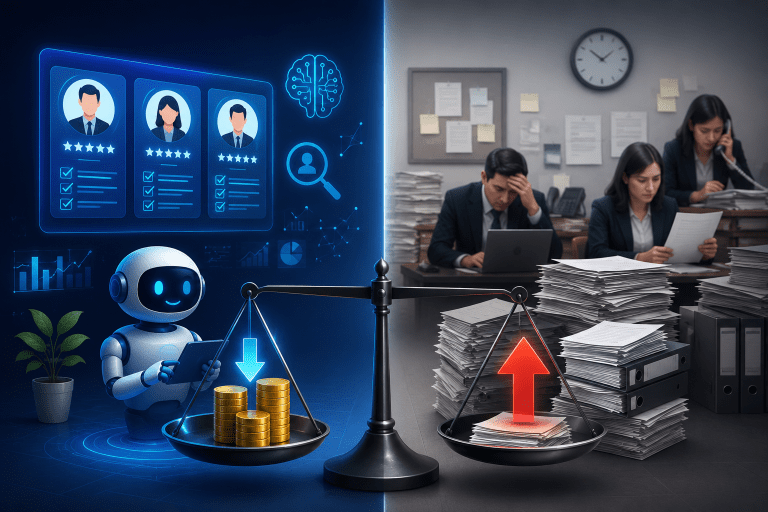
The pressure is put upon you on all sides. The operations desire to have stores manned yesterday. Labor costs are desired to be reduced by finance. Legal desires information that you have taken fair steps in your hiring. In the middle of you are your team, attempting to transport thousands of applicants through what remains very much of a gut feel and short cut process.
Discrimination strikes right at the point where time is of essence. Big volume positions, front line recruitment, seasonal peaks, hourly employees. By basing your recruitment and management on resumes, quick scan and hurried interviews, you are not only losing good talent, you are taking risks. AI bias free hiring has a way out so long as it is constructed to be fair, rather than flashy.
What Is Hiring Bias in Recruitment?
Hiring bias is a type of discrimination; it is any preference or discrimination of a candidate based on non-performance in the job. It creeps in each of the funnel steps. It has an impact on who is sourced, who is screened, who is interviewed and what offers are made.
There are instances where bias is deliberated. Most frequently it is concealed within patterns and habits. Mostly, a recruiter is biased towards candidates in some schools. A manager would like to have individuals with the same accent. A leader of a store puts faith in a hunch after a conversation of five minutes.
The prejudice is manifested in various ways in an impartial recruitment procedure that you desire to achieve but still lack in reality:
- Affinity bias: You like to hire people who seem like those you already have on your staff, a process that traps homogeneity.
- Halo Effect: This is one characteristic of a resume, such as a spectacular brand name, overshadowing the entire profile.
- Confirmation bias: This is the tendency to think of one thing quickly and then seek evidence that reinforces your view.
- Status quo bias: You are simply a company that has always been the type of hire, even when results are poor.
Using high volume hiring these trends scale rapidly. Prejudice does not just involve a single position. It defines whole frontline teams within stores, warehouses, restaurants and at call centers. It elevates turnover, wastes training.
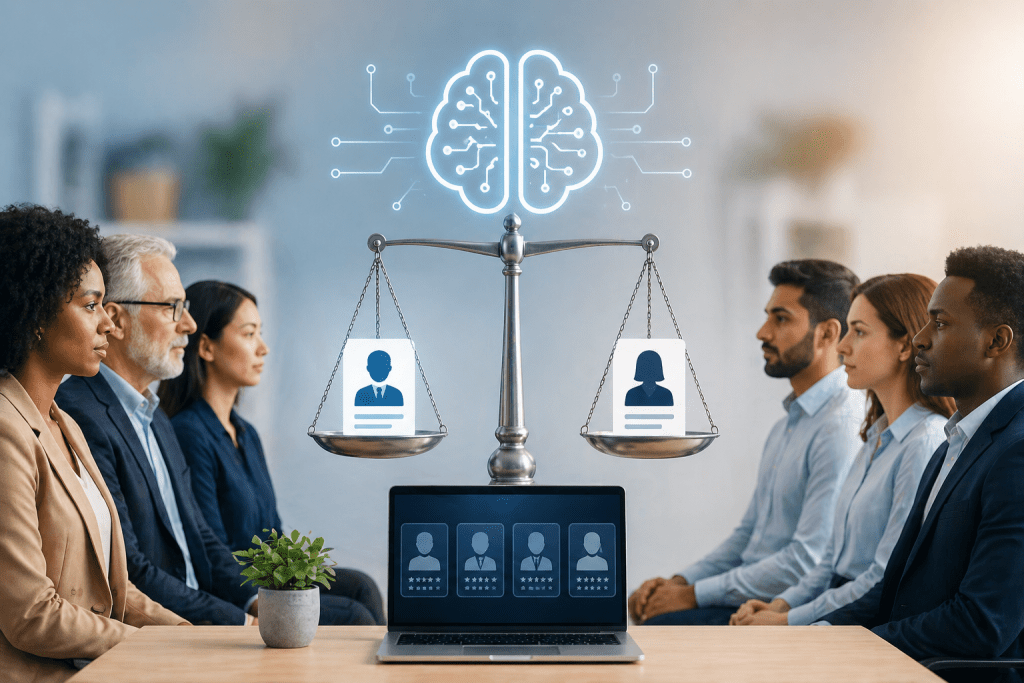
These patterns should be broken by AI bias free hiring. It is not aimed at automating the unsupervised decisions. The idea is to base recruitment decision-making on homogeneous signals, which relate to performance and retention.
Also Read: Using AI to Reduce Hiring Bias
Why Traditional Hiring Processes Create Bias
Conventional recruitment processes were designed in a sluggish world. They are not responsive to contemporary volume, speed and candidate expectations. The harder you interfere with numerous applicants, the more biased you get, rather than less.
Subjective resume review
Resume review invites bias. Recruiters search through names, addresses, schools, gaps and job titles. None of them alone are predictive of performance in a frontline position. They are not empty, since it is the thing that human beings base themselves on that one first.
Two job applicants of equal potential are regarded differently all due to the fact that one of the resumes appears to be well-dressed. Other ones get sieved out due to career gap with no background. This negates your objective of eliminating hiring bias through AI or any other application due to the subjectivity of the first impression.
Unstructured interviews
High volume hiring is done through most conversational interviewing. Managers have walk in customers, staff requests and interviews. They pose various questions every time. They take minimal notes. They depend on impressions rather than on systematic standards.
The outcome is spotty appraisal. Personality fit is overvalued whereas proven behaviors are undervalued by interviewers. It complicates the countermeasures of AI recruitment fairness since it does not have a direct standard of training against.
Speed pressure without guardrails
When in need, individuals compromise. They skip reference checks. They do not pay attention to red flags since a schedule has to be covered tomorrow. They employ the individual who appears to be okay and not the individual who is most likely to remain and deliver.
The conventional processes seldom connect decisions with outcomes. You do not observe individual correlations between all hiring options and turnover cost and time to proficiency. In the absence of data, bias remains unseen. The patterns of hiring are the same each time.
How AI Helps Reduce Hiring Bias
AI in itself does not correct anything. You must have systems that are consistent with transparent rules, clean data and responsible practices. In tangible measurable terms, when you insert those pieces in place, AI can minimize hiring bias during the recruitment process.
Standardizing evaluation criteria
High volume hiring forces clarity on an AI that was created. You establish the indicators that are important to being successful in a position. Track record of attendance, fluctuation in schedule, ease in dealing with customers, capability to adhere to procedures. These are organised rather than mediocre impressions.
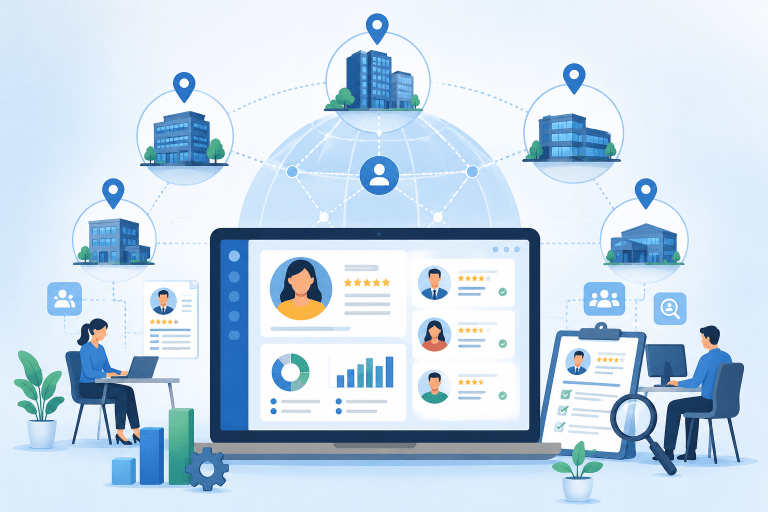
Using applications such as SmartMatch ™ and SmartScore ™ within the Cadient SmartSuite, all applicants are evaluated using the same criteria. You switch to gut feel to regular scoring. It helps to hire an AI-free since all the candidates are subjected to equal rules.
Reducing noise from resumes
Front line jobs can be reduced with the use of an AI driven workflow. They do not take long form documents, but answer specific questions that are job related. The system rates responses according to trends associated with high performance and retention.
This lessens the role played by names, formatting, and educational pedigree. You eliminate hiring bias with AI because it requires that you focus on who fits into the job and not who looks impressive on paper.
Predicting retention, not background
Conventional recruiting screens previous positions and positions. Such predictive models as SmartTenure 8 do analyze what kind of traits in a candidate are likely to be retained in your particular environment in the long term. This is not aimed at benefiting some demographics. This is aimed at rewarding those who remain and work.
This is a fair way to use AI; it promotes an objective recruitment process without slacking the recruitment process. It the system identifies candidates that have a higher likelihood of remaining despite their background appearing unconventional to a human inspector.
Structured, data driven shortlists
The fairness of AI recruitment also enhances the daily activities of recruiters and managers. They do not have to go through hundreds of applicants and get ranked shortlists using SmartMatch™ and SmartScore™ results.
Shortlists are not initiated by triggering personal biases but on job relevant signs. The final decision remains in the hands of the manager, however, the point of departure is more objective and result-oriented.
Continuous feedback loops
The hiring system with AI can be trained to operate based on results when presented with the appropriate data. Every recruit links to tenure, performance, attendance and disciplinary records. The model is not intuitive, but it is adjusted to match scores with real-world outcomes.
This positive feedback increases AI bias-free hiring. You cease to reward appearances that are attractive but which are associated with the speedy exits. You bring up patterns that are silent but promote success in various divisions of your workforce.
AI and Diversity Hiring Outcomes
Hiring of diversity with the help of AI is not related to the imposition of demographic quotas. It is also about taking away the irrelevant noise such that the qualified candidates who are members of the underrepresented groups are not filtered out due to false reasons.
Widening the top of the funnel
Recruitment process and reduces drop off rooted in subjective first passes.
Smart AI sourcing approaches such as those in SmartSource™provide you with access to wider carrier pools. It is possible to experiment with channels, job descriptions, and times. The system reveals how the combinations of choices produce stronger and more varied flows of applicants.
Standardizing screening in the initial years will give every candidate an equal opportunity to advance. That will help in a fair hiring process and decrease subjective first impression drop off.
Equal treatment in screening and ranking
The AI models that do not take into account the attributes which are under protection and target behavioral and experiential data are more consistent in treating candidates. The SmartScore ™ and SmartMatch ™ operate based on feature sets that rely on performance and retention, and therefore, the system will not be obsessed with universities, addresses, and name patterns.
In the course of time you may see changes in the people who get interviews and offers. When AI is used in diversity hiring, it is being based on quantified transformation, rather than a motto.
Visibility into representation and outcomes
AI systems report that assists you in seeing the movement of various groups through your funnel. You can check on whether there is uneven drop off produced by some steps. This helps in the AI recruitment equality since you will be able to modify the process, training, or setting where gaps are present.
De-escalating and demographic reporting in combination provides you with a realistic picture of equity in your hiring engine. You need not guess where prejudice abides. You observe it within the data and act in specific ways.
Ethical AI and Responsible Recruitment Practices
Using AI on the hiring process is a risky affair when you apply it without any foresight. Ethical artificial intelligence recruitment needs guardrails, governance, and accountability. Technology is not a substitute of human responsibility. It sharpens it.
Clear purpose and scope
Each AI feature has to have a purpose. As an example, the SmartScore ™ prioritizes applicants on the basis of role fit. SmartTenure™ features probable retention. SmartScreen™ simplifies background checks. They both occupy a certain position in your workflow.
In the case of clear purpose, AI recruitment fairness is easier to measure. You will be able to determine whether the system is attentive to the correct signals and whether they are based on the company values and the legislation.
Data quality and feature selection
The question of ethical hiring of AI is according to what you feed it. You have to eliminate the characteristics that are directly related to safeguarded attributes. You also look at proxy characteristics that are too correlated with them e.g. some geographic characteristics or even restricted lists of institutions.
Vendors such as Cadient insert controls into SmartSuite™ to make models limited to signals that are relevant to the business, such as work history patterns, shift flexibility, job related responses. The decisions help in ensuring AI bias free hiring.
Human oversight at critical decisions
AI must not conceal decisions, but assist in making them. The recruiters and hiring managers remain informed. They think of scores, rationales behind and main factors. They continue to be responsible of offers and refuses.
Such a combination of signal and judgment ensures that unbiased recruitment process is maintained in line with your culture and compliance posture. You get rid of the black box results and create an understandable audit trail.
Transparent communication with candidates
Ethical AI recruiting is also respectful towards candidates. You tell them in case AI aids in some aspects of the process. You provide them with simple language on the use of information, and the decision making process.
Openness creates trust as well as in the case of groups that were previously marginalized. When individuals learn that AI driven system is going to judge them all using the same standards, they consider your recruiting process more fair.
Also Read: Predictive Hiring Analytics: How to Use Data to Improve Quality of Hire and Retention
Challenges of Using AI for Bias Reduction
AI is not magic. It indicates the information and regulations you select. Unless you control those inputs, then you risk building automated bias on a large scale. Bias in historical data In case your legacy hiring targeted some profiles, historical data contains the pattern. The bias may be recreated by a naive AI model that is trained on those records. It may give preference to the same schools, backgrounds and regions that had been offered previously.
Fairness checks are necessary to check the hiring bias in the case of AI. You consider the variation in predictions of groups regardless of job performance. You rebalance where necessary, retrain.
Overreliance on scores
Scores bring structure. They also create a risk. There are teams which consider them as fallopian indicators. They lose sight of the fact that the AI approach to recruitment needs to rely on human judgments and contexts.
This is where policy and training are involved. Scores guide attention. They do not replace judgment. They are one of the many inputs used by managers and in all cases related to job relevant criteria.
Regulatory and legal complexity
The regulators are still perfecting regulations on AI in hiring. You require those vendors who are current and give records of the way models operate, which data they take and how you audit fairness.
Cadient creates SmartSuite™ with compliance support. You are given transparency into configuration and decision logic, that you can defend your AI bias-free hiring program with.
Change management in the field
The best AI system does not work when managers of the stores disregard it. Resorting to real AI recruitment fairness requires that you base the process on daily habits. It is to say that it will be easy work, easy to use, and training that demonstrates how the system safeguards their time and outcomes to frontline leaders.
SmartTexting™ and SmartScreen™ assist in integrating AI in natural processes. Managers do not switch complex systems to schedule interviews and roll candidates through screens. The background work is done by AI.
Future of Bias-Free Recruitment with AI
Hiring will not be the same way it was. The high volume employers will also be relying on AI as a fundamental operating system approach to recruiting. The three priorities that the winners will balance will be fairness, speed, and retention.
From one time audits to continuous monitoring
In the contemporary world, it is common for organizations to consider bias reviews as an irregular compliance audit. AI systems will track the fairness in the near future within the roles, regions, and hiring managers.
Alerts will be displayed when drop off trends change or when individual score thresholds give disproportionate results. This transforms AI bias free recruitment into a practice rather than a policy.
From generic models to role specific intelligence
AI will not be as broad and generic. High volume hiring requires models that are job trained, location trained and workforce trained. SmartMatch™ and SmartTenure™ are already specifically targeted at intelligent high volume hiring and are going to be further enhanced as more and more rich signals are fed into them.
This accuracy reinforces the objectivity of the recruitment process, since each job employs the indicators that are relevant to that that performance, rather than a generalized speculation across jobs and sectors.
From transactional hiring to workforce health
AI is going to make you look at hiring decisions as the way to affect the health of the workforce in the long-term rather than a single transaction. The candidate scores will be linked to turnover, engagement and promotion journeys.
Fairness in AI recruitment is a subset of an overall plan to maintain stable workforce, decrease turnover, and safeguard the brand image in customer facing positions.
Your next step
When you continue to hire on gut feel, you continue to pay to get out of the house fast, you continue to pay to train waste, and you continue to pay to take compliance risk. When you attach generic AI uncontrollably, you are at risk of laying new technology behind controls the same problems you had before.
You require intelligent high volume hiring that is AI constructed to assist in diminishing hiring prejudice using AI and faster approaches which do not take slower. Cadiant SmartSuitetm is all about that and SmartSource™, SmartMatch™, SmartScore™, SmartTenure™, SmartScreen™, and SmartTexting™ go hand-in-hand to establish a self-directed and balanced recruitment process, one that is retention-driven and equitable. Watch Cadient match AI hiring with bias reduction, diversity, and retention targets, and put an end to guesswork with a hiring system that performs under stress.